The Global Fertility Crisis: Why Birth Rates Are Plummeting Worldwide

Something unprecedented is happening across the globe: people are having fewer babies than ever before. From bustling Tokyo to the rolling hills of Tuscany, from Seoul’s skyscrapers to Madrid’s historic plazas, maternity wards are growing quieter. The global fertility decline isn’t just a statistic—it’s a demographic earthquake that’s reshaping economies, societies, and the very future of humanity. Countries that once worried about overpopulation now scramble to encourage their citizens to have children, often with little success. So what’s driving this worldwide baby bust, and what does it mean for our future?
Understanding the Global Fertility Decline: Current State and Statistics
To grasp the magnitude of this crisis, we need to understand what demographers call the replacement rate fertility—the number of children each woman needs to have to maintain a stable population. That magic number is approximately 2.1 children per woman. Anything below that, and populations eventually shrink.
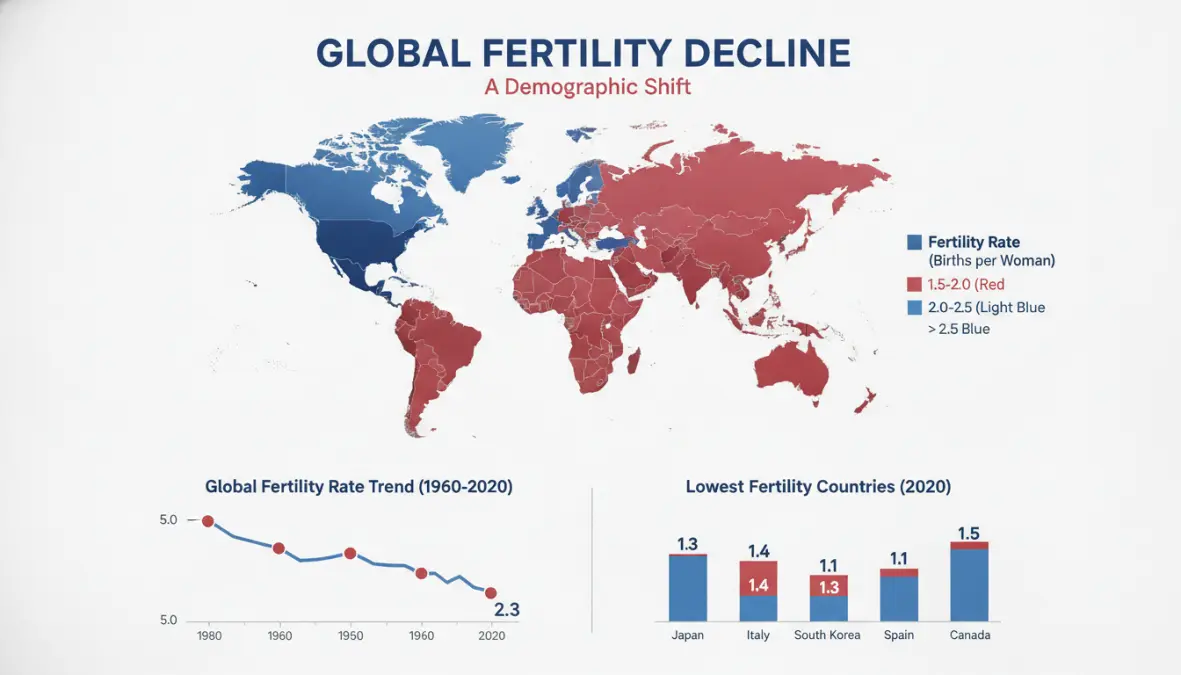
Here’s the stark reality: more than half of the world’s population now lives in countries with declining birth rates worldwide below replacement level. The global total fertility rate has plummeted from around 5.0 in the 1960s to approximately 2.3 today—and it’s still dropping. According to recent fertility rate statistics, this represents one of the fastest demographic transitions in human history.
The low fertility countries paint an even more dramatic picture. South Korea holds the dubious distinction of having the world’s lowest fertility rate at around 0.7—meaning the average Korean woman has less than one child in her lifetime. Japan hovers around 1.3, Italy at 1.2, and Spain at 1.2. Even China, after decades of strict population control, now faces a fertility rate of just 1.0 despite abandoning its one-child policy.
This demographic transition isn’t limited to wealthy nations anymore. Countries across Latin America, the Middle East, and parts of Asia are experiencing rapid fertility declines. Thailand’s rate has dropped to 1.1, Iran’s to 1.7, and Brazil’s to 1.6. What took European nations a century to experience is happening in developing countries within a single generation. The question isn’t whether birth rates are falling—it’s why are birth rates falling in developed countries and beyond at such an alarming pace.
Why Are Birth Rates Falling? The Key Drivers Behind the Fertility Crisis
The causes of the global fertility crisis are complex and interconnected, spanning economics, culture, and individual choice. Unlike past population changes driven by disease or famine, today’s population decline trends stem from voluntary decisions—people choosing to have fewer children or none at all.
Understanding these drivers requires looking at how modern life has fundamentally changed the calculus of parenthood. Economic pressures, shifting social norms, changing gender roles, and broader cultural transformations have converged to make having children less appealing or simply less feasible for millions of people worldwide.
Economic Pressures and the Cost of Raising Children
Perhaps nothing illustrates the economic uncertainty fertility connection better than the eye-watering costs of parenthood today. In the United States, raising a child from birth to age 18 costs an estimated $310,000—not including college tuition. Housing affordability crisis means many young adults can’t imagine fitting children into their one-bedroom apartments or affording homes with extra bedrooms in desirable school districts.
Childcare costs alone can consume 20-30% of household income in many developed nations. Student debt burdens delay major life milestones—the average millennial carrying educational loans postpones homebuying, marriage, and children by several years. Meanwhile, wage stagnation means that despite dual incomes becoming the norm, families feel financially stretched thin.
The necessity of two incomes creates a catch-22: both parents need to work to afford children, but working makes having children logistically and financially challenging. This economic reality fundamentally shifts the economic impact of declining birth rates, creating a self-reinforcing cycle where economic concerns suppress fertility, which in turn creates economic problems like workforce shortages. These global economic pressures often intertwine with broader crises, including geopolitical tensions reshaping supply chains and increasing costs worldwide.
Social and Cultural Shifts in Modern Society
Beyond economics, profound social changes have transformed attitudes toward parenthood. Women’s educational and career opportunities have expanded dramatically—a positive development that nonetheless impacts fertility timing and total births. The average maternal age trends show first-time mothers are now in their late twenties or early thirties in most developed countries, up from early twenties just a generation ago.
This delay narrows the reproductive window and often results in fewer total children. Career establishment, finding the “right” partner, achieving financial stability—these prerequisites for parenthood take longer to achieve than ever before. Social pressure to have children has also diminished significantly. The ChildFree movement has gained mainstream acceptance, normalizing the choice to remain childless as a valid lifestyle option rather than a selfish aberration.
Individualism and personal fulfillment have become central values in modern societies, sometimes conflicting with the sacrifices parenthood requires. The definition of family has diversified beyond the traditional nuclear model. Climate anxiety, concerns about bringing children into an uncertain future, and changing relationship patterns all contribute to population decline trends. This sense of social disconnection and changing values mirrors broader societal shifts, much like the loneliness epidemic reshaping human connections.

Consequences and Solutions: Navigating Population Decline and Aging Societies
Global population aging represents the flip side of falling birth rates. As fertility drops and life expectancy rises, societies are becoming top-heavy with elderly citizens. Japan offers a preview: adult diapers now outsell baby diapers, and more than 28% of the population is over 65. The aging population challenges are staggering—pension systems designed for growing populations face insolvency, healthcare systems strain under increasing demand, and the ratio of working-age adults to retirees shrinks alarmingly.
The economic consequences cascade through society. Workforce shortage threatens productivity and economic growth. When populations shrink, so do domestic markets, consumer demand, and tax bases. Real estate markets can collapse as more homes become available than there are families to fill them. Schools close, universities struggle for students, and entire communities can enter demographic death spirals.
Immigration and population growth have become increasingly important as native-born populations decline. Countries like Canada and Australia have embraced immigration as demographic strategy, while others like Japan and South Korea have been more resistant, despite desperate need. However, immigration alone cannot solve the problem when fertility rates plummet globally—eventually, there won’t be enough young people anywhere to balance aging populations.
Regarding fertility crisis solutions, various government policies to increase birth rates have been implemented with mixed results. Scandinavian countries and France have achieved modest success through comprehensive family planning policies: generous parental leave (up to 480 days in Sweden), subsidized childcare, child allowances, and flexible work arrangements. France’s fertility rate of 1.8 is among Europe’s highest, though still below replacement.
Financial incentives alone rarely move the needle significantly. Hungary offers substantial payments, tax breaks, and even mortgage forgiveness for families with multiple children, yet fertility remains stubbornly around 1.5. Singapore’s generous “baby bonus” programs haven’t reversed declining rates. The lesson? Money helps, but cultural and structural changes matter more.
Real solutions require addressing root causes: affordable housing, work-life balance, gender equality that doesn’t force women to choose between career and family, accessible reproductive health services, and cultural shifts that value parenting as much as professional achievement. Yet even successful interventions show us how to reverse fertility decline only partially—no country has managed to boost fertility back above replacement level once it has fallen significantly below.
The demographic collapse represents one of humanity’s most profound challenges this century. As resources like water become scarcer in many regions, the interplay between population trends and resource availability becomes even more complex. We stand at a crossroads where the question isn’t just about having more babies—it’s about fundamentally reimagining how societies support families, value care work, and balance individual fulfillment with collective sustainability. The countries and communities that navigate this transition successfully will shape what human civilization looks like for generations to come.