The Care Economy: Why Unpaid Domestic Work Remains Invisible and Undervalued

Every day, billions of hours are spent worldwide on tasks that keep households running, families fed, and loved ones cared for. Yet this work—cooking, cleaning, childcare, eldercare, emotional labor—rarely shows up in economic statistics, job descriptions, or policy discussions. Welcome to the care economy, a vast but largely invisible system that forms the backbone of all economic activity, yet remains systematically undervalued and overwhelmingly performed by women without pay.
What Is the Care Economy and Why Does It Matter?
The care economy encompasses all the labor—both paid and unpaid—required to care for people and maintain households. It includes unpaid care work like preparing meals, cleaning homes, raising children, supporting aging parents, and providing emotional support, as well as paid care services like nursing, childcare centers, and home health aides.
Economists traditionally distinguish between “productive” labor (activities that generate market value and contribute to GDP) and reproductive labor (activities that sustain human life and enable productive work). Here’s the problem: reproductive labor is systematically excluded from GDP calculations, rendering it economically invisible despite being absolutely essential. Without someone caring for children, elderly relatives, or maintaining homes, the formal economy simply couldn’t function.
This invisible labor includes concrete, time-consuming activities: bathing a toddler, driving aging parents to medical appointments, managing household schedules, grocery shopping, doing laundry, helping with homework, organizing family celebrations, and countless other tasks. These aren’t trivial activities—they’re fundamental to human wellbeing and societal functioning. Yet because they happen primarily within private households and aren’t exchanged for money, traditional economics treats them as non-work.
Understanding the care economy matters because recognizing this work as genuinely economic opens possibilities for policy changes, fairer distribution of labor, and better support for caregivers who currently shoulder these responsibilities largely alone.
The True Scale of Unpaid Domestic Work: Statistics and Economic Impact
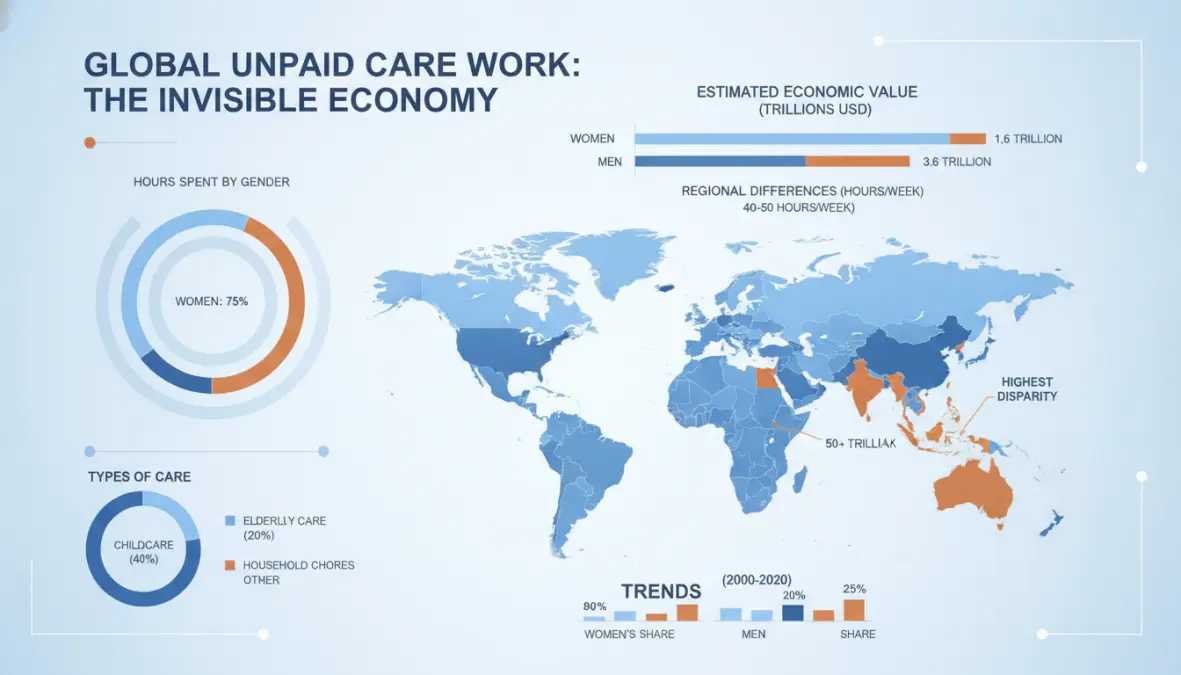
The numbers behind unpaid domestic work are staggering. According to the International Labour Organization (ILO), people globally spend approximately 16.4 billion hours daily on unpaid care work. If valued at minimum wage rates, this would represent an economic contribution of roughly $10.8 trillion annually—equivalent to about 9% of global GDP.
OECD time use surveys reveal that women perform between two and ten times more unpaid care and domestic work than men, depending on the country. In developed nations, women average 4.5 hours daily on unpaid care work compared to men’s 2 hours. In developing countries, this gap widens dramatically, with women spending up to 6-8 hours daily on these tasks.
McKinsey research estimates that if women’s unpaid work were properly accounted for, it would add between $2-4 trillion to economic output measures in major economies. The methodology for calculating the economic value of unpaid domestic work typically uses either replacement cost (what it would cost to hire someone) or opportunity cost (what caregivers could earn in paid employment instead).
The COVID-19 pandemic dramatically illustrated this hidden infrastructure. With schools closed and eldercare facilities restricted, unpaid care work surged—particularly for women. Research showed women’s unpaid care work increased by an average of 30% during lockdowns, while men’s increased by only 15%, actually widening the gender gap.
Gender Disparities in Unpaid Care Work
The impact of unpaid care work on women extends far beyond daily time allocation. Women’s disproportionate care burden directly limits their women’s economic participation, contributing significantly to the gender pay gap. Women are more likely to work part-time, interrupt careers, or exit the workforce entirely due to caregiving responsibilities.
This pattern creates long-term economic consequences: reduced lifetime earnings, smaller pension contributions, and greater economic vulnerability in old age. According to UN Women, if women’s unpaid care work were reduced and redistributed to match men’s levels, an additional 600 million women could enter the formal labor market globally. The connection between unpaid care burdens and limited career advancement is well-documented—something also explored in discussions about how younger generations are rethinking career success with greater emphasis on work-life balance.

Why Care Work Remains Invisible: Economic, Cultural, and Policy Factors
Several interconnected factors explain why unpaid care work remains invisible in economic thinking. First, there’s the structural exclusion from GDP accounting. National accounting systems were designed to measure market transactions, not household production. This wasn’t accidental—it reflects historical assumptions about what constitutes “real” economic activity.
The separation between public (valued, economized) and private (personal, non-economic) spheres has deep roots in gender inequality. Historically, women’s work within households was constructed as a “natural” expression of femininity rather than labor deserving compensation. These cultural narratives persist, making care work seem like a gift of love rather than economically valuable work.
Feminist economics has long challenged these frameworks, arguing that the economy depends on social reproduction—the daily and generational renewal of human beings. Without care work, there would be no workers, no consumers, no economy. Yet mainstream domestic labor economics still largely operates within paradigms that treat this work as supplementary rather than foundational.
Policy structures reinforce this invisibility. Tax systems, social security, pension schemes, and labor regulations are designed around formal employment, offering little recognition or support for unpaid caregivers. This creates a care deficit—insufficient resources allocated to meeting society’s care needs—that disproportionately burdens families, especially women.
Recognizing and valuing the care economy could transform economic policy. Comprehensive childcare subsidies, generous parental leave policies (for all genders), eldercare support, and care worker protections would acknowledge care as collective responsibility rather than private burden. Countries like Sweden and Iceland have made progress through policies that encourage more equal distribution of care work and support formal care services—approaches that contrast sharply with the workplace transformations demanded by workers in recent years.
Movements for recognizing unpaid domestic labor have proposed various solutions: including unpaid work in national accounts through satellite accounts, implementing universal basic income that recognizes care contributions, mandating time use surveys to track care work patterns, and creating care credits for pension systems. Some advocates have even suggested calculating unpaid care work and GDP together to provide a fuller picture of economic health.
FAQ
How much is unpaid care work worth globally?
According to ILO estimates, unpaid care work globally is worth approximately $10.8 trillion annually when valued at minimum wage—about 9% of global GDP. Some calculations using higher wage rates suggest it could represent up to 13% of GDP, making it larger than many entire industry sectors.
Why is unpaid care work considered invisible labor?
Unpaid care work is considered invisible labor because it’s excluded from GDP calculations, happens within private households away from public view, and isn’t exchanged for money. Traditional economic frameworks fail to recognize activities that don’t generate market transactions, despite their essential role in sustaining the economy.
How does unpaid domestic work affect women’s economic participation?
Women’s disproportionate responsibility for unpaid domestic work significantly limits their economic participation. It reduces working hours, interrupts careers, limits advancement opportunities, and contributes to the gender pay gap. Globally, women perform 2-10 times more unpaid care work than men, directly constraining their participation in formal employment.
What would happen if care work was included in GDP calculations?
Including care work in GDP would increase measured economic output by 9-13% globally and would fundamentally shift how we understand economic value. It would make women’s economic contributions visible, potentially justify policy investments in care infrastructure, and challenge assumptions about what constitutes productive work. Several countries now produce satellite accounts tracking this.
What are some solutions to better value care work?
Promising care economy policy solutions include subsidized childcare and eldercare services, paid parental leave for all genders, care credits for pension systems, living wages for paid care workers, regular time use surveys to track unpaid work, and including unpaid care in national economic accounts. Cultural change promoting equal distribution of care responsibilities is equally important.
The care economy isn’t peripheral to “real” economics—it’s foundational. Until we recognize, measure, and fairly distribute this work, we’ll continue operating with incomplete economic data and perpetuating profound gender inequalities. The question isn’t whether care work has economic value, but when we’ll finally start acting like it does.