Right to Disconnect Laws: Which Countries Legally Protect After-Hours Boundaries

Picture this: it’s 9 PM on a Tuesday, you’re finally relaxing on the couch, and your phone buzzes with a work email marked “urgent.” Your heart sinks. Do you respond now and sacrifice your evening, or risk looking uncommitted? For millions of workers worldwide, this scenario plays out daily. But here’s the good news: a growing number of countries have decided enough is enough, introducing right to disconnect laws that legally protect employees from after-hours work intrusion. Let’s explore which nations are leading the charge in protecting employee disconnection rights and what these off-duty communication laws actually mean for workers and employers alike.
What Is the Right to Disconnect?
The right to disconnect laws represent a fundamental shift in how we view work boundaries in our hyper-connected world. At its core, this concept gives employees the legal right to ignore work-related communications outside their regular working hours without facing negative consequences. Think of it as a protective shield against the “always-on” culture that’s become increasingly toxic in our smartphone era.
These digital disconnect policies emerged as a direct response to the blurring lines between professional and personal life, accelerated by remote work and digital transformation. When your office lives in your pocket, the traditional 9-to-5 becomes meaningless unless there are clear boundaries. The problem? Constant connectivity contributes to employee burnout, stress, and even social disconnection, undermining both mental health and productivity.
Legally, employee disconnection rights typically mean employers cannot require workers to answer emails, calls, or messages during off-hours, cannot penalize them for not responding, and must establish clear policies about after-hours communication expectations. Some laws go further, requiring companies to implement training and create written agreements. It’s crucial to distinguish between legally binding off-duty communication laws and voluntary corporate policies—the former carries real enforcement mechanisms and penalties, while the latter depends on company culture and goodwill. The impact on work-life balance is profound: employees report better sleep quality (something proper circadian rhythms also support), reduced anxiety, and improved overall wellbeing when they can truly disconnect.
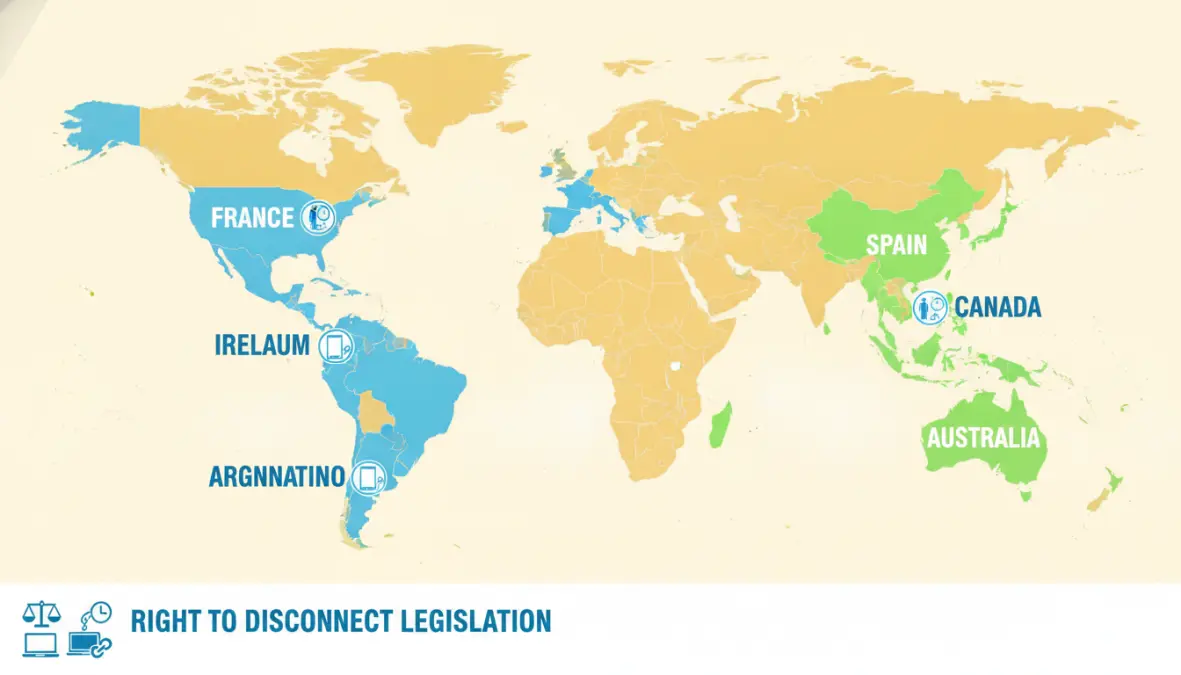
Countries That Have Enacted Right to Disconnect Legislation
The global landscape of right to disconnect legislation has evolved rapidly over the past decade, with over a dozen countries now offering some form of legal protection. While approaches vary—from comprehensive national laws to sector-specific regulations—the underlying principle remains consistent: protecting workers from the expectation of constant availability. Let’s break down which countries have taken the leap and what their after hours work laws actually entail.
Europe: Leading the Way in Employee Protection
Europe has been the undisputed pioneer in establishing work-life balance regulations through right to disconnect frameworks. France blazed the trail in January 2017 with its groundbreaking El Khomri law, becoming the first country to enshrine this right in legislation. The French law applies to companies with 50+ employees and requires them to negotiate agreements defining when workers can disconnect. While penalties aren’t explicitly financial, employers risk labor tribunal actions and reputational damage for non-compliance. So, how does right to disconnect work in France? Companies must establish clear policies through collective bargaining, and employees have the explicit right to ignore work emails after hours without repercussions.
Italy followed suit in 2017 as part of its Jobs Act reforms, focusing particularly on remote and smart workers. The Italian approach requires written agreements between employers and employees outlining rest periods and technical measures to ensure disconnection. Spain joined the movement in 2018, then strengthened its legislation in 2021, mandating that companies with remote workers establish clear disconnection policies and face potential fines for violations. Portugal took a unique angle in 2021, specifically targeting remote work scenarios and actually imposing fines on employers who contact employees outside working hours—except in emergencies. Companies with 10+ employees must comply, making Portugal’s law one of the strictest.
Belgium introduced sector-specific legislation in 2022, initially covering employees in certain industries before potential expansion. Ireland implemented its Code of Practice in 2021, providing guidance rather than strict legal mandates but establishing clear expectations for workplace boundary protection. Slovakia rounds out the European contingent with legislation requiring employers and employees to agree on disconnection terms. The common thread across European implementations? A recognition that digital detox regulations are essential for modern workplace wellbeing, though enforcement mechanisms and penalties vary significantly by country.

Right to Disconnect Beyond Europe
The movement isn’t confined to Europe. Argentina made history as the first Latin American country to adopt right to disconnect protections in 2021, specifically for remote workers, prohibiting employers from contacting employees outside agreed hours. This was particularly significant given Argentina’s tech sector growth and the challenges many workers faced during pandemic-era remote work transitions.
Canada’s Ontario province introduced legislation in 2022 requiring employers with 25+ employees to have written policies about disconnecting from work, though notably, the law doesn’t actually prohibit after-hours contact—it simply requires transparency about expectations. Australia took a more robust approach through amendments to the Fair Work Act, giving employees in certain circumstances the right to refuse unreasonable after-hours contact. Mexico included disconnection rights in its federal labor law reforms, while the Philippines has active bills under consideration, reflecting growing awareness of these issues across diverse economic contexts.
The cultural and enforcement differences between regions are striking. European countries tend toward stronger regulatory frameworks with clearer penalties, while North American approaches often favor disclosure and policy requirements without strict prohibitions. As remote work continues evolving globally, these regional variations will likely influence how multinational companies structure their policies.
What These Laws Mean for Employers and Employees
Understanding what countries have right to disconnect laws is one thing—grasping the practical implications is another. For employers, compliance typically requires several concrete steps: drafting clear written policies that define working hours and disconnection expectations, training managers and staff on the legal right to ignore work emails after hours, implementing technological solutions that prevent or flag after-hours communications, and cultivating a company culture that genuinely respects boundaries rather than just paying lip service to the law.
For employees, these labor law protections translate to tangible rights: you can legitimately not respond to that late-night email without fearing it’ll impact your performance review or job security. It’s the legal right to ignore work emails after hours without professional consequences. However, most legislation includes reasonable exceptions for genuine emergencies, on-call arrangements with proper compensation, or senior roles where after-hours availability is explicitly part of the job description and compensation package.
Implementation challenges are real, especially for global companies navigating multiple time zones. How do you respect a Paris employee’s disconnection rights when your New York office is mid-workday? Forward-planning, asynchronous communication tools, and cultural shifts toward respecting out of office boundaries become essential. Best practices include setting email delivery delays, encouraging status indicators, and leadership modeling healthy disconnection behaviors.
Looking forward, momentum is building. The UK has seen parliamentary discussions about introducing similar legislation, while various U.S. states and cities are considering local ordinances. Even without legal mandates, forward-thinking companies worldwide are proactively implementing employee burnout prevention measures through voluntary disconnection policies, recognizing that protecting employment rights and wellbeing isn’t just ethical—it’s good business that reduces turnover and increases productivity.
The question isn’t whether more countries will adopt these protections, but when. As work continues evolving and the mental health costs of constant connectivity become impossible to ignore, the right to disconnect is transforming from a progressive idea into a fundamental labor right—one that recognizes humans need rest, boundaries, and lives beyond their inboxes.