Swarm Robotics: How Insect-Inspired Robots Work Together to Solve Complex Problems
Ever watched a flock of birds swirl across the sky in perfect coordination, or seen ants build intricate colonies without a single supervisor? Nature’s been mastering teamwork for millions of years, and now engineers are bringing these strategies into the robotics lab. Swarm robotics takes inspiration from these tiny creatures to create armies of simple robots that, when working together, can tackle problems that would stump even the most sophisticated individual machine. It’s not science fiction—it’s happening right now in warehouses, disaster zones, and research labs worldwide.
What Is Swarm Robotics and How Does It Work?
At its core, swarm robotics represents a paradigm shift in how we think about automation. Instead of building one incredibly complex robot packed with sensors and processing power, bio-inspired robotics takes a different approach: create many simple robots that coordinate their actions through swarm intelligence. This concept of collective robotics mirrors what we observe in social insects like ants, bees, and termites—individually simple creatures that collectively achieve remarkable feats.
The beauty lies in four fundamental principles: decentralization (no single leader calling the shots), scalability (add more robots without redesigning the system), robustness (if one fails, others continue), and flexibility (adapt to changing conditions). Individual robots follow simple rules based on local information, yet their interactions create complex, emergent collective behavior that appears intelligent and purposeful. Think about it: a single ant is pretty basic, but an ant colony can build underground cities, farm fungus, and wage strategic warfare.
Compare this to traditional robotics. A single complex robot might cost hundreds of thousands of dollars, require constant maintenance, and create a single point of failure. Meanwhile, a swarm of simpler autonomous swarm robots might cost less collectively, provide redundancy, and scale to match the task at hand.
Core Principles of Swarm Intelligence
Understanding how do swarm robots communicate with each other starts with grasping five key principles. First, local sensing and communication—robots only interact with nearby teammates, much like ants touching antennae. Second, simple individual rules—each robot follows basic instructions like “move toward light” or “avoid obstacles.”
Third comes self-organization, where global patterns emerge without central control. Picture fish schooling to avoid predators—no leader fish is directing traffic. Fourth, there’s emergence, the phenomenon where collective capabilities exceed individual ones. Finally, stigmergy allows robots to communicate indirectly through environmental modifications, just as ants leave pheromone trails. These principles power everything from ant colony optimization algorithms to flocking algorithms used in drone coordination.
Key Components of Multi-Robot Systems
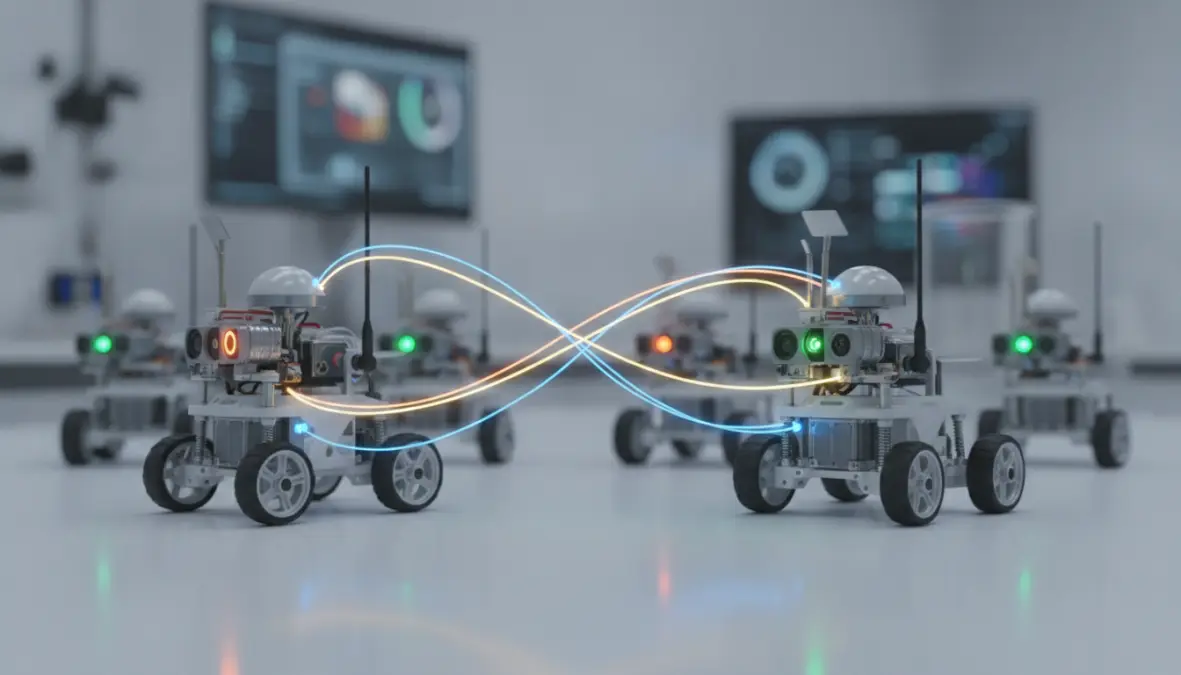
Multi-robot systems require specific hardware and software components. Each robot typically carries proximity sensors, cameras, or LIDAR for environment mapping. Communication happens through wireless protocols (WiFi, Bluetooth) or even visual signaling using LEDs. Robot coordination algorithms process this data, implementing distributed artificial intelligence that allows decisions without centralized computing.
The hardware often favors simplicity and cost-effectiveness. Think small wheeled platforms with basic microcontrollers—nothing fancy. The real magic happens in the coordination mechanisms: consensus algorithms, formation control, task allocation protocols, and collision avoidance systems. Much like how AI personal assistant productivity is transforming the way we work through distributed intelligence, swarm robots leverage distributed processing to achieve computational efficiency.
Real-World Applications and Problem-Solving Capabilities
Swarm robotics applications in real world scenarios are expanding rapidly. In search and rescue operations, swarm robotics for disaster response allows dozens of robots to explore collapsed buildings simultaneously, covering ground faster than any single robot could. Each robot maps its section, shares findings wirelessly, and adapts as the environment shifts—crucial when every minute counts.
Environmental monitoring has become another sweet spot for distributed robotics. Underwater swarms monitor coral reef health, while aerial drones track deforestation patterns across vast territories. The advantages of swarm robotics over single robots shine here: one robot breaks down, the mission continues; the area expands, you add more units; conditions change, the swarm adapts organically.
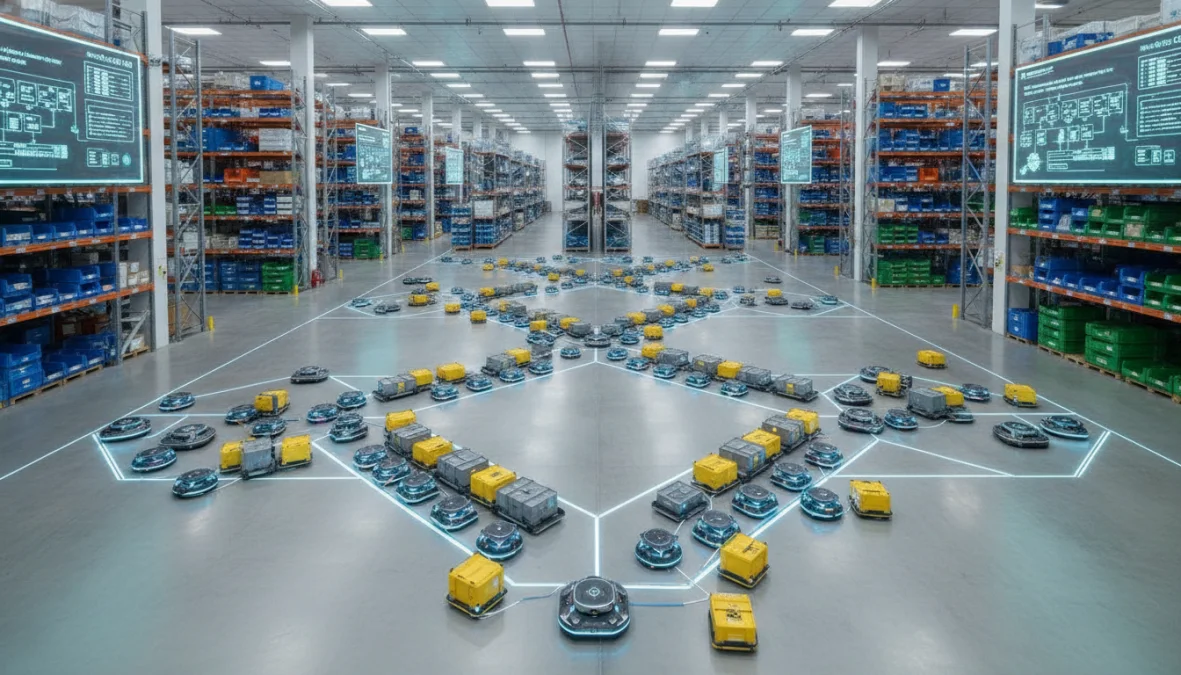
Warehouse automation is perhaps the most commercially mature application. Companies deploy swarms of mobile robots that coordinate to move inventory, sort packages, and optimize storage—all without a central traffic controller creating bottlenecks. Agricultural robotics sees swarms handling tasks like precision weeding, pollination monitoring, and crop health assessment across large fields.
In construction, experimental swarms inspired by termites can collectively build structures, each robot placing bricks according to simple rules that produce complex architectural forms. Military and defense applications explore reconnaissance swarms that can saturate an area with sensors while remaining resilient to individual unit losses. The scalability in robotics these systems offer means adapting to mission scope by simply adjusting swarm size.

Challenges and Future Directions in Swarm Robotics
Despite promising advances, swarm robotics faces significant hurdles. Programming emergent behavior remains counterintuitive—developers can’t directly code desired outcomes, only individual rules that hopefully produce them. Decentralized control in swarm robotics makes debugging nightmares since there’s no single point to troubleshoot when things go wrong.
Communication management presents constant headaches. How do you ensure reliable data exchange when dozens of robots compete for bandwidth? Insect-inspired algorithms for robot swarms work beautifully in simulation but often stumble when radio interference, physical obstacles, or network latency enter the picture. Energy management compounds this—coordinating battery life across a swarm while maintaining mission effectiveness requires sophisticated protocols.
Hardware scalability sounds great in theory, but manufacturing hundreds of identical, reliable, affordable units remains challenging. Fault tolerance needs improvement too; while swarms handle individual failures better than single robots, cascading failures can still cripple entire systems.
Future directions look exciting though. Integrating machine learning allows swarms to improve coordination strategies through experience. Heterogeneous swarms mixing different robot types could tackle more complex tasks—imagine flying drones coordinating with ground rovers and aquatic units. Human-swarm interaction research explores intuitive control interfaces, letting operators guide swarms like shepherds rather than micromanaging individuals.
Standardization efforts aim to create common platforms and protocols, similar to how quantum networks are developing communication standards. Commercial adoption will likely accelerate over the next decade as costs drop and algorithms mature, though full autonomy in unstructured environments remains years away.
Frequently Asked Questions
What is the difference between swarm robotics and traditional robotics?
Traditional robotics typically involves single, complex machines with centralized control, while swarm robotics employs many simple robots using decentralized control and local interactions. Swarms achieve complex tasks through collective behavior rather than individual sophistication, offering better scalability and fault tolerance.
What animals inspire swarm robotics?
Social insects primarily inspire bio-inspired robotics—ants for foraging algorithms, bees for task allocation, termites for construction behaviors. Fish schools influence flocking patterns, while bird formations inspire aerial drone coordination. These natural systems demonstrate effective self-organization without central leadership.
Are swarm robots expensive?
Individual autonomous swarm robots are typically designed to be simple and affordable, often costing hundreds rather than thousands of dollars. However, deploying functional swarms requires multiple units, so total system costs vary. The trade-off offers redundancy and scalability traditional systems can’t match.
What are the main advantages of swarm robotics?
Key advantages include robustness (failure of individuals doesn’t stop the mission), scalability (easily adjust swarm size to task requirements), flexibility (adapt to changing conditions), and area coverage (efficiently handle large or complex spaces). These benefits make collective robotics ideal for unpredictable environments.
The future of automation isn’t necessarily bigger, smarter individual machines—it might just be thousands of simple robots working together with the collective wisdom nature’s been perfecting for eons. As these technologies mature, we’ll see swarms handling everything from planetary exploration to microscopic medical procedures, proving that sometimes, many hands really do make light work.