Quantum Internet Explained: How Quantum Networks Will Transform Digital Communication
Imagine a world where your messages can’t be intercepted, where data breaches become physically impossible, and where information travels using the strange rules of quantum mechanics rather than electrical signals. Sound like science fiction? Welcome to the emerging reality of quantum internet explained—a revolutionary technology that’s set to redefine how we think about digital communication, security, and connectivity.
While the internet you’re using right now relies on classical bits (0s and 1s) transmitted through cables and wireless signals, quantum internet operates on fundamentally different principles borrowed from quantum physics. It’s not just a faster version of what we have—it’s an entirely new paradigm that could make today’s encryption methods look like locks made of paper.
What Is Quantum Internet and How Does It Work?
At its core, quantum internet explained boils down to this: it’s a network that uses quantum bits (qubits) and the bizarre phenomenon of quantum entanglement to transmit information. Unlike classical internet, where data packets travel from point A to point B through routers and switches, a quantum network leverages quantum states that can exist in multiple configurations simultaneously.
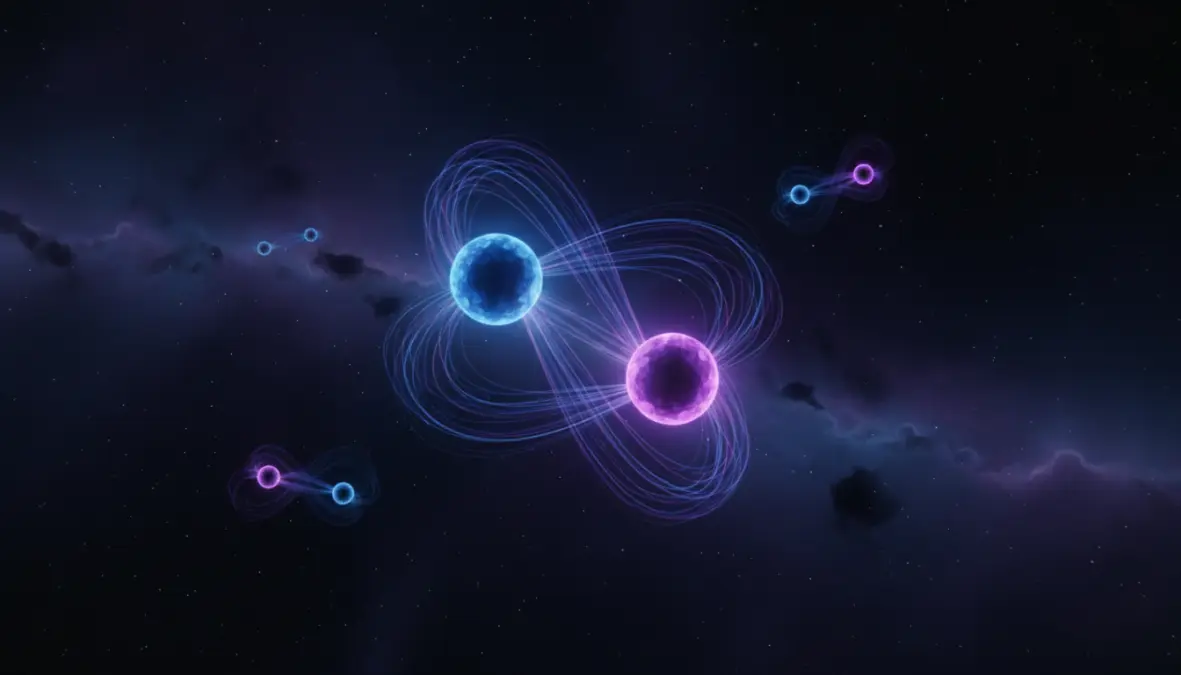
Here’s a simple analogy: imagine you have two magic coins that are quantum entangled. When you flip one and it lands on heads, the other instantly shows tails—no matter if they’re separated by centimeters or light-years. This “spooky” connection (as Einstein famously called it) forms the backbone of how quantum entanglement internet works. Instead of sending information through physical channels the traditional way, quantum networks use these entangled particles to share information in ways that classical physics simply can’t replicate.
The fundamental difference between quantum internet vs classical internet lies in the nature of information itself. Classical bits are definite—always either 0 or 1. Qubits, however, can be in a superposition of both states simultaneously until measured. This quantum technology explained in practical terms means exponentially greater information density and fundamentally different communication protocols.
Quantum Entanglement: The Backbone of Quantum Networks
The magic ingredient that makes quantum entanglement internet possible is a phenomenon Einstein skeptically dubbed “spooky action at a distance.” When two particles become entangled, measuring the state of one instantly affects the state of the other, regardless of the distance separating them. This isn’t about signals traveling faster than light—it’s about a correlation that exists outside our classical understanding of space and time.
In quantum networks, pairs of entangled qubits form the communication channels. Through photon entanglement, scientists can create these linked particles and distribute them across fiber optic quantum channels. When you want to send secure information, you measure your qubit in a specific way, which instantaneously correlates with its entangled partner. This connection enables quantum teleportation—not of matter, but of quantum states—allowing information transfer that’s fundamentally different from anything classical networks can achieve.
Key Applications and Technologies Powering Quantum Communication
So how does quantum internet work in practice? The most mature application today is quantum cryptography, specifically through quantum key distribution (QKD). This technology is already being tested by banks, government agencies, and research institutions who need absolutely secure communication channels. China has deployed a quantum satellite network, and European nations are building ground-based quantum networks connecting major cities.
The integration with quantum computing networks represents another frontier. While quantum computers themselves are still developing, connecting them via quantum internet could create a distributed quantum computing infrastructure. Imagine research labs across continents sharing quantum processing power to solve problems in drug discovery, climate modeling, or cryptanalysis that would take classical computers millennia to crack.
Financial institutions are particularly interested because the benefits of quantum internet technology include transaction verification that’s mathematically guaranteed to be tamper-proof. Healthcare organizations see potential in sharing sensitive patient data with absolute privacy. National security agencies view it as essential infrastructure for the coming era when quantum computers might break current encryption standards.
Quantum Key Distribution: Unbreakable Encryption
Quantum key distribution represents the most significant quantum internet security advantage available today. Here’s why it’s revolutionary: according to Heisenberg’s uncertainty principle, you cannot observe a quantum system without disturbing it. This means if someone tries to intercept your quantum-encrypted message, the act of eavesdropping itself changes the quantum states being transmitted, instantly alerting both sender and receiver to the security breach.
Compare this to classical cryptography, which relies on mathematical complexity—the assumption that certain problems are too hard to solve quickly. But “too hard” isn’t the same as “impossible.” A sufficiently powerful quantum computer could theoretically break RSA encryption and other standards protecting today’s internet traffic. Quantum cryptography, by contrast, is protected by the laws of physics themselves, not just computational difficulty. You can’t hack the uncertainty principle.
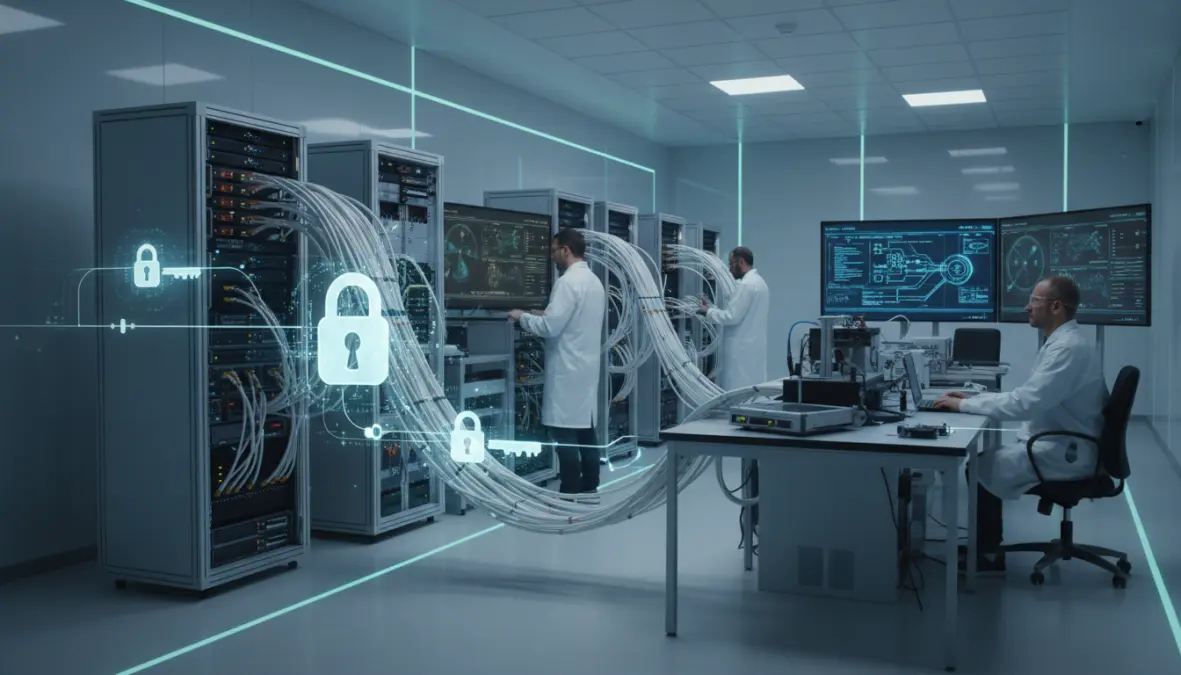
Organizations implementing QKD use specialized hardware to generate entangled photons, transmit them through dedicated fiber optic lines, and establish shared secret keys that are provably secure. These keys can then encrypt classical data transmissions, creating a hybrid approach that bridges quantum and classical networks.
Current Challenges and the Road Ahead for Quantum Internet
Despite the exciting potential, significant obstacles stand between today’s experimental systems and a fully functional global quantum network. The biggest challenge is quantum decoherence—quantum states are incredibly fragile and collapse when they interact with their environment. This makes maintaining qubits transmission over long distances extremely difficult. Current fiber optic systems can transmit entangled photons reliably for about 100-150 kilometers before the signal degrades beyond usefulness.
To solve this, researchers are developing quantum repeaters—devices that can extend quantum signals without destroying the entanglement. Unlike classical repeaters that simply amplify signals, quantum repeaters must perform complex operations involving quantum memory and entanglement swapping. These technologies are still in early experimental stages.
When will quantum internet be available for average users? Realistically, we’re looking at a phased rollout. Specialized secure communication networks for governments and critical infrastructure are already operational in limited form. Metropolitan-area quantum networks connecting universities and research centers are expanding. But a consumer-facing quantum internet that replaces or significantly augments classical internet is still likely decades away.
Current projects like the Quantum Internet Alliance in Europe and the development of quantum protocols for standardization are laying groundwork. The future of quantum internet communication will likely involve hybrid systems where quantum links handle security-critical functions while classical infrastructure continues managing bulk data transfer. As quantum computing networks mature and quantum repeater technology advances, we’ll gradually see expanded coverage and new applications we haven’t yet imagined.

FAQ: Common Questions About Quantum Internet
What’s the main difference between quantum and classical internet?
Classical internet transmits information using electrical or light signals representing definite 0s and 1s. Quantum internet uses quantum particles in superposition states and leverages entanglement for fundamentally different communication methods. The key distinction is that quantum networks enable provably secure communication and could connect quantum computers in ways impossible with classical infrastructure.
When will quantum internet be available to consumers?
Specialized quantum communication networks already exist for research and security applications, but widespread consumer availability is likely decades away. The technology must overcome significant challenges including distance limitations, hardware costs, and the need for quantum repeaters. Most experts predict gradual integration starting with critical infrastructure before consumer rollout.
Will quantum internet replace our current internet?
Not likely—at least not completely. The future of quantum internet communication will probably involve hybrid systems where quantum links provide ultra-secure channels for sensitive data while classical networks continue handling everyday web browsing, streaming, and bulk data transfers. Each technology has strengths suited to different applications.
How does quantum internet provide better security?
Quantum cryptography and quantum key distribution make eavesdropping physically detectable due to quantum mechanics principles. Any attempt to intercept quantum-transmitted information disturbs the quantum states, alerting users to the breach. This provides security based on physics laws rather than computational complexity, making it fundamentally more secure than classical encryption.
What are quantum repeaters and why do we need them?
Quantum repeaters are devices that extend the range of quantum communication by refreshing quantum signals without destroying entanglement. We need them because quantum states degrade (decohere) quickly over distance—current systems work reliably only for 100-150 km. Developing practical quantum repeaters is essential for building long-distance quantum networks.
The quantum internet isn’t just an incremental upgrade—it’s a fundamental reimagining of how information can be shared, secured, and processed. While we’re still in the early stages, the combination of quantum entanglement, cryptography, and emerging quantum technologies promises a future where digital communication is faster, more secure, and built on the fascinating principles of quantum mechanics. The question isn’t if quantum networks will transform our world, but how profoundly they’ll reshape everything from privacy to computing to our understanding of connection itself.