Living Building Materials: How Self-Healing Concrete and Bio-Bricks Are Revolutionizing Construction
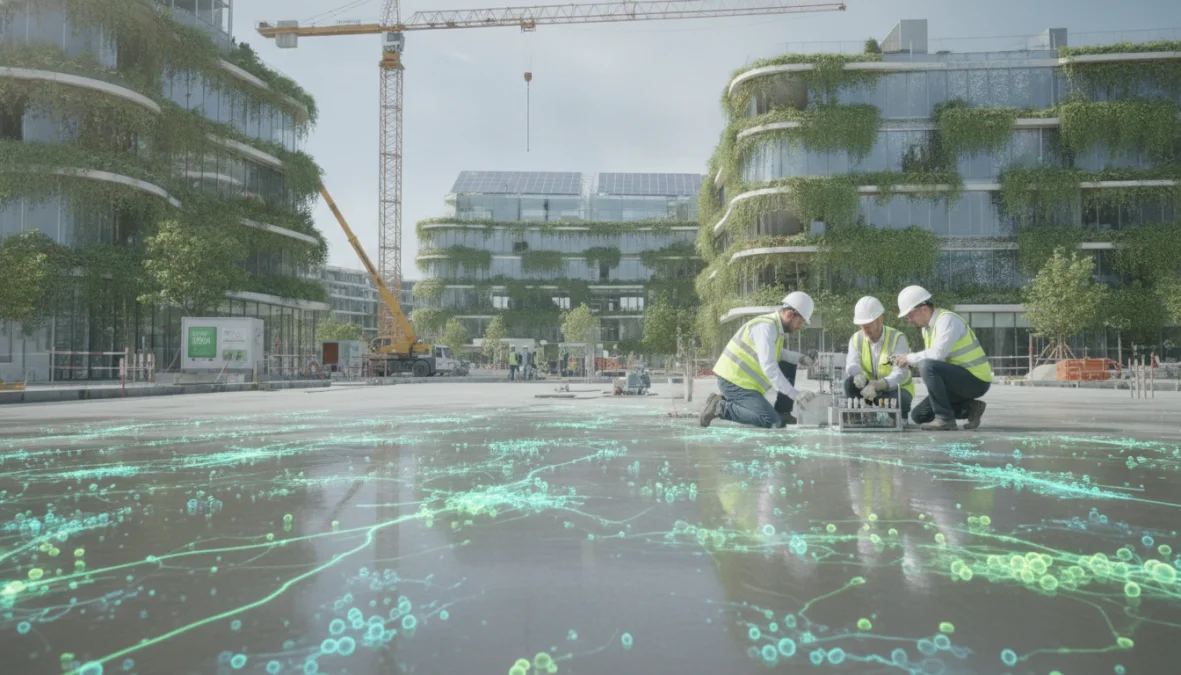
Imagine buildings that can heal themselves when damaged, bricks grown from bacteria instead of fired in kilns, and construction materials that actively reduce carbon emissions rather than contribute to them. Sounds like science fiction? Well, it’s happening right now. Living building materials are transforming the construction industry from the ground up, bringing biology and architecture together in ways we’ve never seen before. From self-healing concrete that patches its own cracks to bio-bricks cultivated with microorganisms, these innovations aren’t just cool—they’re potentially game-changing for sustainable construction and the planet’s future.
What Are Living Building Materials and How Do They Work?
Living building materials represent a radical departure from traditional construction approaches. Unlike conventional concrete, steel, or bricks, these biological construction materials incorporate living organisms—primarily bacteria, fungi, and other microorganisms—directly into their structure. The key difference? They’re not just inert substances; they’re dynamic systems capable of growing, adapting, and even repairing themselves.
At the heart of this revolution is biomimetic construction—the practice of learning from and mimicking nature’s strategies. Just as our skin heals cuts or bones mend fractures, living building materials can respond to damage autonomously. The two most prominent categories making waves today are self-healing concrete and bio-bricks. Both rely on microbial processes, but they work in distinctly different ways.
The science behind these materials centers on biomineralization—the process by which living organisms produce minerals. Certain bacteria species can precipitate calcium carbonate, essentially creating limestone through their metabolic processes. When engineered into building materials, these microorganisms become tiny construction workers, operating at a microscopic level to strengthen, bind, or repair the material around them. It’s a perfect example of how green construction technology is borrowing from billions of years of evolutionary innovation.
Self-Healing Concrete: The Bacteria-Powered Solution
Concrete might seem solid and permanent, but it’s actually quite vulnerable. Cracks form due to temperature changes, settling, and stress—and those cracks let in water, which causes corrosion and structural weakness. Traditional repairs are expensive and labor-intensive. Enter self-healing concrete, a bacteria-based concrete that can fix itself without human intervention.
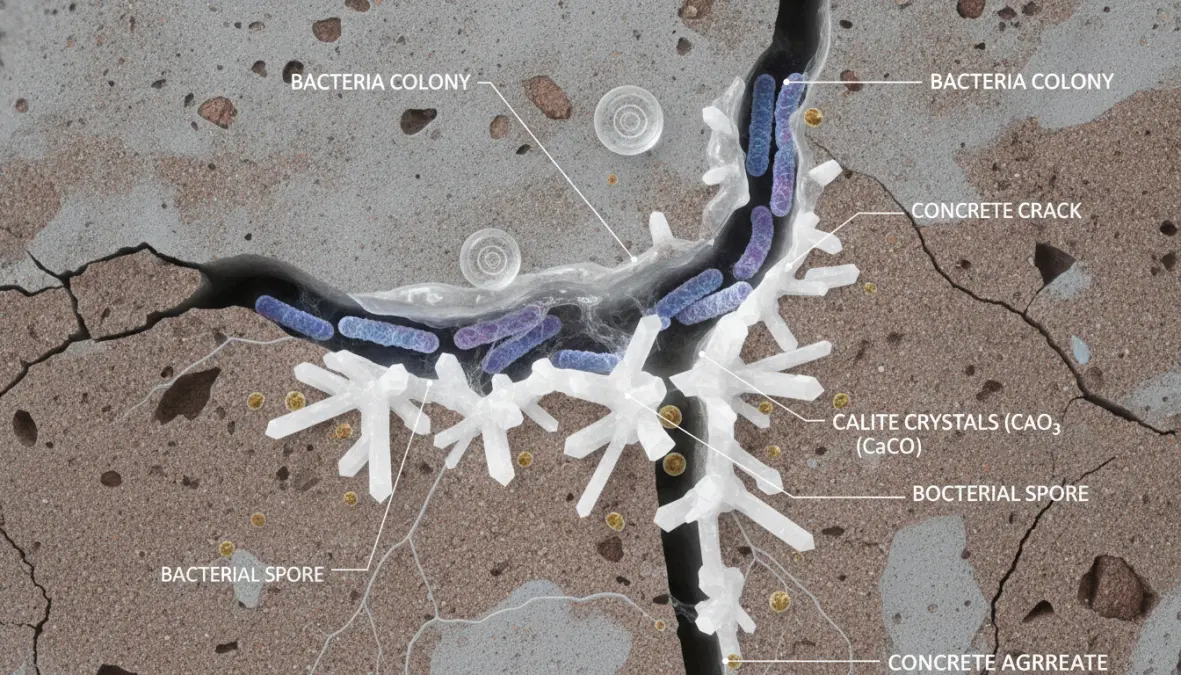
How Bacterial Spores Repair Cracks From Within
So, how does self-healing concrete work? The secret lies in dormant bacterial spores mixed into the concrete during production. The most commonly used species is Bacillus, chosen because these hardy bacteria can survive the harsh alkaline environment inside concrete for decades without food or water. They’re basically in suspended animation, waiting for the right conditions.
When a crack forms and water seeps in, it’s go-time for the bacteria. The moisture activates the dormant spores, bringing them back to life. As they metabolize nutrients also embedded in the concrete (typically calcium lactate), they produce calcium carbonate—limestone—as a byproduct. This calcite precipitates along the crack walls, gradually filling the gap from the inside out. Within a few weeks, cracks up to 0.8mm wide can be completely sealed, restoring the concrete’s structural integrity and waterproofing.
The beauty of this regenerative building technology is that it’s automatic and repeatable. As long as bacteria remain viable (which can be 200+ years), the concrete can heal itself multiple times. Different research teams are experimenting with various bacterial strains and nutrient sources to optimize healing speed and crack-filling capacity, making microbial concrete increasingly effective.
Real-World Applications and Performance Benefits
Self-healing concrete isn’t just a lab curiosity anymore—it’s being tested in real infrastructure projects worldwide. Parking structures, bridge decks, and underground tunnels are particularly promising applications, where traditional repairs are costly and disruptive. In the Netherlands, several road trials have shown that self-healing concrete can extend infrastructure lifespan by 30% or more, dramatically reducing maintenance costs over time.
The benefits of living building materials like this extend beyond just convenience. Reduced need for repairs means fewer construction crews on site, less traffic disruption, and significantly lower carbon emissions from repair materials and equipment. While the cost of self-healing concrete vs traditional concrete is currently 10-30% higher upfront, the long-term savings from reduced maintenance can make it economically attractive for critical infrastructure. As production scales up and the technology matures, costs are expected to drop substantially. Much like how digital twin technology is revolutionizing infrastructure monitoring, self-healing concrete is changing how we maintain our built environment.
Bio-Bricks and Other Living Construction Materials
Bio-bricks take a different approach to biological construction. Instead of embedding bacteria in traditional materials, these sustainable building materials are literally grown using microorganisms. Researchers have developed processes where bacteria are mixed with sand and fed nutrients in molds. As the bacteria metabolize, they produce biocement—calcium carbonate that binds sand particles together, creating solid bricks without any firing or high-temperature processing.
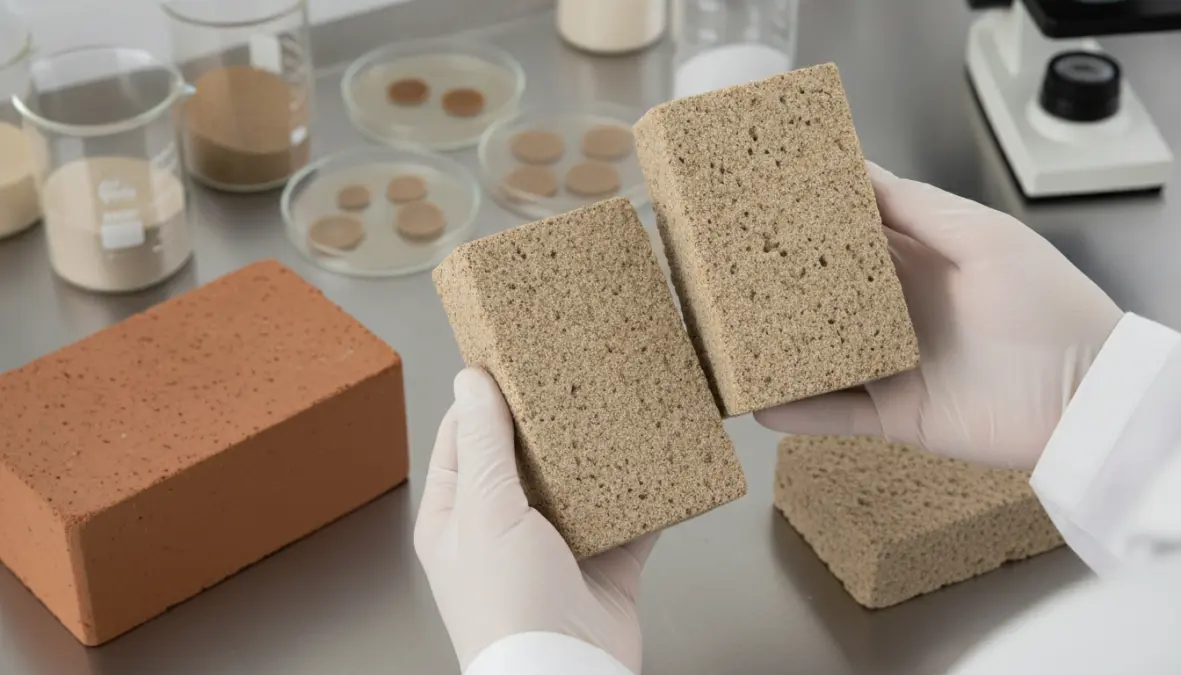
What are bio-bricks made of? Typically, they consist of sand, bacteria (often Sporosarcina pasteurii), urea, and calcium sources. The bacteria convert urea into ammonium and carbonate ions, which then react with calcium to form calcium carbonate crystals. This mineralization process happens at room temperature, requiring no kiln firing—a massive environmental win considering traditional brick production is extremely energy-intensive and carbon-heavy.
The environmental benefits are staggering. Manufacturing traditional bricks produces approximately 1.5% of global CO2 emissions due to the high-temperature kilns required. Bio-bricks, by contrast, can be carbon-negative building solutions, actually sequestering CO2 during production. They use far less energy and can even be made using waste materials like agricultural byproducts or construction debris.
Beyond bio-bricks, mycelium construction materials are gaining traction. Mycelium—the root structure of fungi—can be grown in molds with agricultural waste, creating lightweight, insulating panels that are biodegradable at end-of-life. These bioreceptive materials can even support moss or lichen growth on building facades, creating living walls that improve air quality and provide insulation. Companies are also developing bio-based insulation, acoustic panels, and even structural elements, all part of the broader living architecture movement that’s redefining what buildings can be. This aligns perfectly with approaches like adaptive reuse architecture, where sustainability and innovation meet.
FAQ: Common Questions About Living Building Materials
How long do living building materials actually last?
Self-healing concrete can maintain active bacterial populations for 200+ years in ideal conditions, though effectiveness gradually decreases. Bio-bricks have similar durability to conventional bricks once fully mineralized—lasting decades or longer. The living components eventually become dormant or die, but the structural integrity remains since the biological processes create permanent mineral structures.
Are these materials safe for human health?
Absolutely. The bacteria used in self-healing concrete and bio-bricks are non-pathogenic strains specifically selected for safety. They’re sealed within the material structure and pose no health risk. Mycelium materials are also safe, essentially made from the same fungus that produces edible mushrooms. Rigorous testing ensures these sustainable building materials meet all health and safety standards.
When will living building materials be available on a large scale?
Self-healing concrete is already commercially available from several manufacturers, though adoption is gradual due to higher costs. Bio-bricks are still mostly in pilot and demonstration phases, with commercial availability expected within the next few years as production processes are refined and scaled. Applications of living building materials in construction are expanding rapidly as costs decrease and performance data accumulates.
How much more do these materials cost compared to traditional options?
Currently, self-healing concrete costs 10-30% more than traditional concrete upfront, but lifetime cost analysis often favors the bio-version due to reduced maintenance. Bio-bricks production costs are still being optimized—small-scale production is expensive, but industrial-scale manufacturing could reach cost parity with conventional bricks while offering superior environmental benefits. As with many green construction technologies, early adoption costs are higher but decreasing rapidly.
Living building materials aren’t just another incremental improvement in construction—they represent a fundamental rethinking of how we build. By harnessing biological processes that have evolved over millions of years, we’re creating structures that work with nature rather than against it. As these technologies mature and scale, they promise to make our infrastructure more resilient, sustainable, and adaptive. The future of self-repairing infrastructure isn’t just coming—it’s already being poured, molded, and grown today. And that’s genuinely exciting for anyone who cares about building a more sustainable world.