Lab-Grown Leather: How Cellular Agriculture Is Revolutionizing Animal-Free Materials

Imagine a world where luxury leather goods come from labs instead of farms, where no animals are harmed and environmental impact drops dramatically. This isn’t science fiction—lab grown leather is already here, and it’s poised to transform the fashion, automotive, and furniture industries forever. Through the power of cellular agriculture, scientists are growing real leather from cells, creating materials that are molecularly identical to traditional leather but produced in controlled, sustainable environments.
This breakthrough in biotechnology materials represents more than just another vegan leather alternative. It’s a fundamental reimagining of how we produce materials, moving from resource-intensive animal farming to precision biological manufacturing. As consumer demand for sustainable leather alternatives skyrockets and technology costs decline, biofabricated leather is shifting from niche laboratories to mainstream production facilities.
What Is Lab-Grown Leather and How Does Cellular Agriculture Work?
Lab grown leather, also known as cultured leather or cellular agriculture leather, is genuine leather grown from animal cells without raising or slaughtering animals. Unlike plant-based alternatives like cork or pineapple leather, this material is biologically identical to traditional leather because it’s made from the same cells—just cultivated in bioreactors instead of on animals.
Understanding how is lab grown leather made requires looking at three main production methods:
- Collagen-based cultivation: Scientists extract cells from animals (via harmless biopsy), culture them in nutrient-rich media, and grow collagen proteins that form leather’s structure
- Fermentation-based production: Microorganisms like yeast are genetically programmed to produce collagen proteins, which are then assembled into leather-like materials
- Mycelium-based growth: Though technically different from cellular agriculture, mushroom mycelium creates leather alternatives with similar properties (learn more about mycelium leather alternatives)
The cellular agriculture process mirrors principles used in other innovative food production methods, similar to how vertical farming is revolutionizing agriculture. Both represent controlled-environment production that maximizes efficiency while minimizing environmental impact.
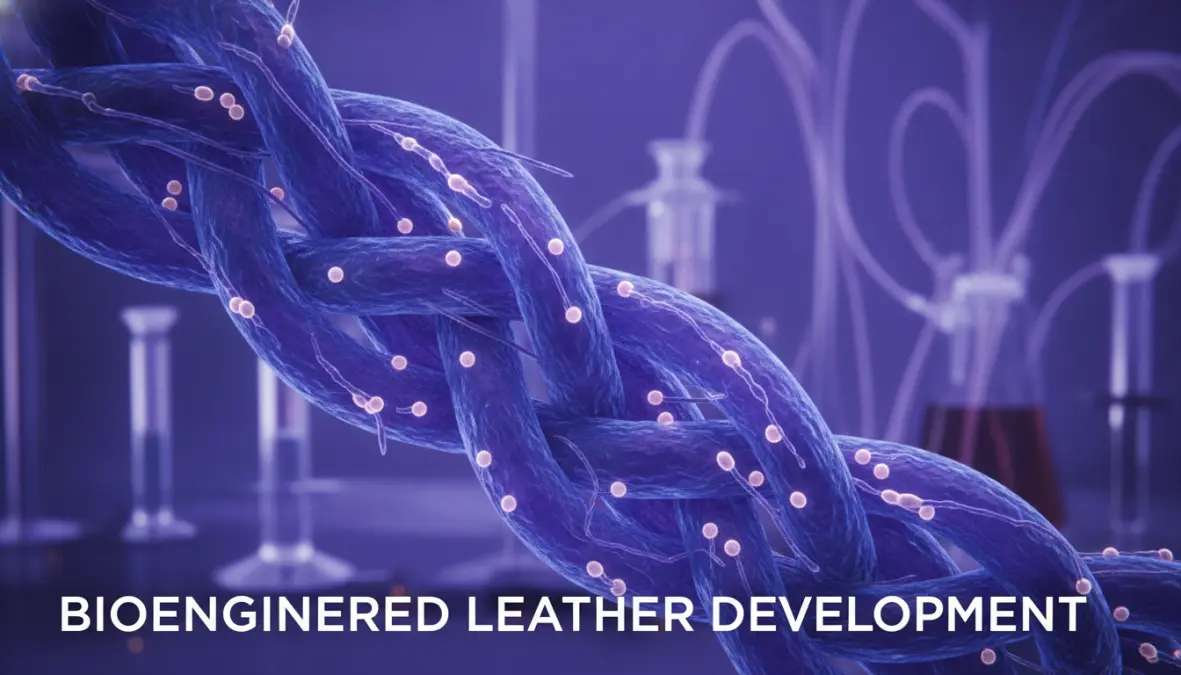
The Science Behind Bioengineered Leather Production
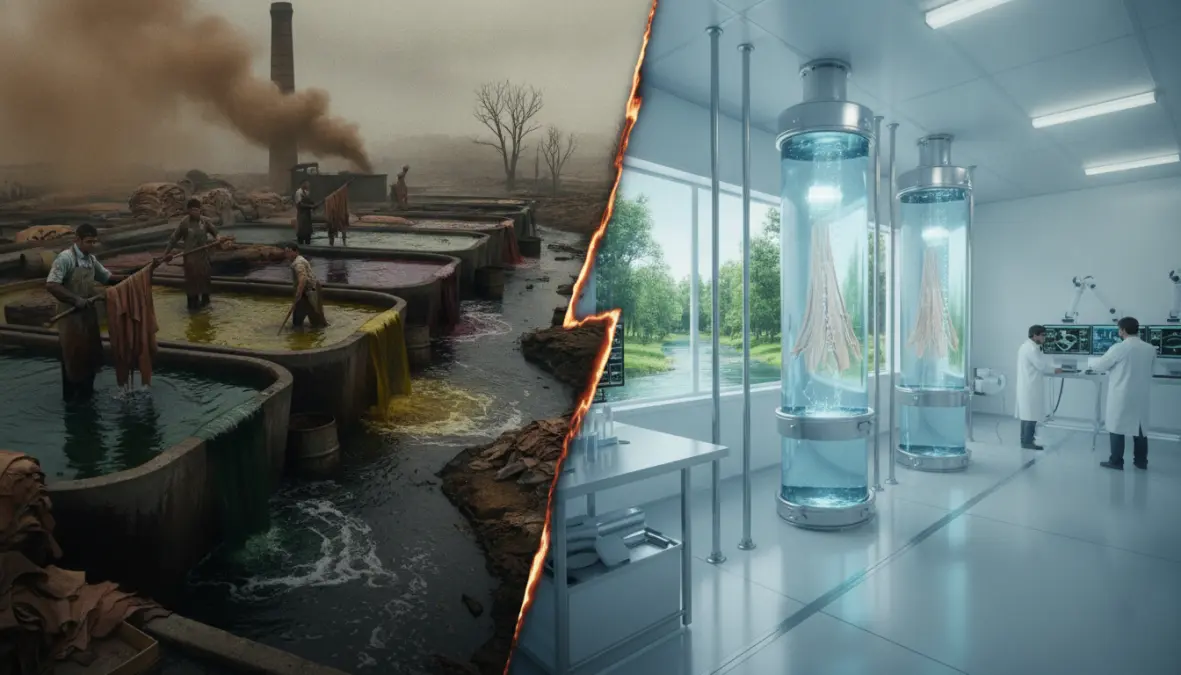
The production of bioengineered leather begins with cell extraction—typically fibroblasts or stem cells obtained through a small, non-invasive biopsy from a living animal. These cells are then placed in bioreactor production systems where they’re fed a nutrient solution containing amino acids, vitamins, and growth factors.
Inside these bioreactors, cells multiply and produce collagen, the protein that gives leather its strength and flexibility. Through tissue engineering techniques, this collagen is organized onto biodegradable scaffolds that provide structure, guiding the material to develop the desired thickness and texture. The entire collagen cultivation process typically takes 2-4 weeks, compared to the 2-3 years required to raise cattle for traditional leather.
Advanced synthetic biology tools allow scientists to fine-tune properties like thickness, durability, and even texture patterns—customization impossible with animal hides. The final material undergoes finishing processes similar to traditional leather tanning, but without the toxic chromium compounds typically used.
Key Differences Between Lab-Grown and Traditional Leather
When comparing lab grown leather vs traditional leather, several critical distinctions emerge:
- Production process: Traditional leather requires raising animals for years, slaughter, and chemical-intensive tanning; lab-grown leather grows in weeks without animal death
- Environmental footprint: Cellular agriculture uses approximately 95% less land, 80% less water, and produces 85% fewer greenhouse gas emissions
- Material consistency: Lab-grown leather has uniform thickness and quality without natural imperfections like scars or insect bites
- Customization potential: Properties can be engineered for specific applications—extra durability for car seats, softness for fashion
- Current costs: Still higher than conventional leather but dropping rapidly as production scales
- Availability: Limited commercial availability currently, expected to expand significantly within 3-5 years
Compared to plant-based vegan leather alternatives, biofabricated leather offers superior durability, breathability, and that distinctive leather feel that synthetic materials struggle to replicate. It bridges the gap between ethical production and premium material performance.
Environmental and Ethical Benefits of Animal-Free Leather
The lab grown leather environmental impact represents a dramatic improvement over conventional leather production. Livestock farming for leather contributes significantly to deforestation, water pollution, and climate change. The tanning process alone discharges toxic chemicals including chromium, formaldehyde, and coal-tar derivatives into waterways.
Research indicates that animal free leather produced through cellular agriculture could reduce:
- Land use by up to 95%, freeing vast areas for ecosystem restoration or regenerative agriculture practices
- Water consumption by 80%, crucial as freshwater scarcity intensifies globally
- Greenhouse gas emissions by 85%, addressing one of fashion’s largest climate contributions
- Chemical pollutants by eliminating traditional tanning processes
Beyond environmental advantages, the ethical case for cellular agriculture animal free materials is compelling. The global leather industry is inseparable from industrial animal agriculture, where billions of animals endure confined conditions before slaughter. Lab-grown leather completely eliminates this suffering while still delivering authentic leather’s properties.
However, transparency demands acknowledging current limitations. Bioreactor production requires energy, and if powered by fossil fuels, carbon savings diminish. The benefits of cellular agriculture leather maximize when production facilities use renewable energy. Additionally, scaling to meet global leather demand (approximately 400 million square meters annually) remains a significant technical challenge. Questions about the true sustainability must consider the entire lifecycle, avoiding greenwashing through rigorous Life Cycle Assessments.
The circular economy potential is particularly exciting—lab-grown leather could be designed for biodegradability or recyclability from the start, unlike traditional leather with chemical treatments that complicate end-of-life processing.
Leading Companies and Commercial Applications of Cultured Leather
Several pioneering companies making lab grown leather are pushing this technology from research labs to commercial reality:
VitroLabs focuses on growing leather tissue from cell cultures, partnering with major brands to develop applications for fashion and automotive industries. Their tissue-engineering approach creates material identical to traditional leather at the molecular level.
Modern Meadow uses fermentation-based biofabrication, programming yeast to produce collagen proteins that are then assembled into their Bio-Alloy material. They’ve collaborated with major fashion houses and have products in limited market release.
Bolt Threads and MycoWorks take the mycelium leather approach, growing materials from mushroom roots rather than animal cells—technically different from cellular agriculture but often grouped with lab grown materials in discussions of next-generation materials.
Commercial applications are expanding beyond fashion into automotive interiors, furniture, and luxury goods. Several automotive manufacturers have announced partnerships to integrate bioengineered leather into vehicle interiors, attracted by customization possibilities and sustainability credentials.
The future of lab grown leather industry timeline suggests limited commercial availability currently, with broader market entry expected within 3-5 years as production capacity scales. Initial pricing remains premium—2-3 times conventional leather costs—but projected to reach price parity by the end of the decade as manufacturing efficiency improves and bioreactor technology advances.
Regulatory frameworks are still developing. The industry needs clear standards for labeling, safety testing, and sustainability claims. Some companies are pursuing certification through existing leather industry bodies, while others advocate for new categories recognizing cellular agriculture’s unique nature.
FAQ: Lab-Grown Leather Questions Answered
Is lab-grown leather really sustainable?
Lab-grown leather offers significant sustainability advantages over traditional leather, including dramatically reduced land use, water consumption, and greenhouse gas emissions. However, true sustainability depends on production energy sources and manufacturing scale. When powered by renewable energy, cellular agriculture leather can reduce environmental impact by 80-95% compared to conventional leather production.
How much does lab-grown leather cost?
Currently, lab-grown leather costs 2-3 times more than conventional leather due to limited production scale and high research costs. As bioreactor technology improves and production capacity expands, industry experts predict prices will reach parity with premium traditional leather within 5-10 years, eventually becoming more cost-effective as the technology matures.
What does lab-grown leather feel like?
Lab-grown leather feels virtually identical to traditional leather because it’s made from the same collagen proteins and cellular structures. It has the characteristic softness, flexibility, breathability, and develops a natural patina over time. Unlike synthetic alternatives, it’s not a leather-like material—it is genuine leather, just grown differently.
Is lab-grown leather vegan?
This depends on definition. Lab-grown leather is animal-free in that no animals are slaughtered, but it typically starts with cells obtained from a living animal via biopsy. Some methods use animal-derived growth media. It’s more accurately described as “animal-free” or “slaughter-free” rather than strictly vegan, though future iterations may use fully synthetic growth media.
When will lab-grown leather be widely available?
Limited commercial products exist now in luxury markets, but widespread availability is projected for 3-7 years from now. Timeline depends on scaling production capacity, reducing costs, and establishing supply chains. Early adoption will likely occur in premium fashion and automotive sectors before expanding to mass-market applications.
How durable is cellular agriculture leather compared to traditional leather?
Lab-grown leather can match or exceed traditional leather durability because production conditions are controlled and material properties can be engineered for specific applications. Unlike animal hides with natural variations and weak points, cellular agriculture creates consistent material throughout. Long-term aging studies are ongoing, but initial results show comparable or superior performance in strength and wear resistance tests.
The revolution in lab grown leather and cellular agriculture represents more than just another sustainable alternative—it’s a fundamental transformation in how we produce materials. As technology advances and production scales, we’re approaching a future where luxury, performance, ethics, and environmental responsibility align perfectly. The leather jacket of tomorrow might be indistinguishable from today’s, except it will have grown in a lab rather than on an animal, marking a profound shift in humanity’s relationship with materials and nature itself.