The Ethics of AI in Healthcare: Who Should Make Life-Saving Decisions?

Picture this: you’re rushed into an emergency room, your life hanging in the balance. A sophisticated AI system analyzes your symptoms, scans your medical history, and recommends a treatment protocol—all within seconds. The doctors follow its advice. But here’s the unsettling question: if something goes wrong, who’s accountable? The algorithm? The hospital? The physician who trusted the machine? As ai ethics healthcare becomes increasingly complex, we’re confronting uncomfortable truths about who should hold the power to make life-saving decisions.
The Growing Role of AI in Medical Decision-Making
AI decision making healthcare isn’t science fiction anymore—it’s happening right now in hospitals worldwide. From radiology departments where algorithms detect cancerous tumors with stunning accuracy to intensive care units where predictive models flag patients at risk of sepsis hours before human clinicians might notice, artificial intelligence patient care has become deeply embedded in modern medicine.
Consider the numbers: AI diagnostic systems for diabetic retinopathy now match or exceed ophthalmologist accuracy rates, correctly identifying the condition in over 90% of cases. IBM’s Watson for Oncology analyzes cancer cases and suggests treatment options based on millions of medical papers and clinical trial data. In emergency departments, AI triage systems help prioritize patients based on severity, potentially saving lives when every minute counts.
The appeal is obvious. AI diagnostic tools ethics aside, these systems don’t get tired during a 16-hour shift, don’t suffer from cognitive bias after seeing similar cases repeatedly, and can process vastly more data than any human brain. They’re particularly powerful in medical imaging—chest X-rays, CT scans, MRIs—where pattern recognition is crucial. Some studies suggest AI can detect pneumonia from chest X-rays more accurately than individual radiologists.
But as these tools become more sophisticated and autonomous, they’re moving beyond mere assistance. They’re increasingly involved in deciding which patients get flagged for immediate attention, which treatment protocols get recommended, and even predicting patient outcomes. That’s where the ethical complications begin.

Core Ethical Challenges in Healthcare AI
The integration of medical AI ethics into healthcare reveals profound challenges that go beyond technical performance. We’re not just asking whether AI works—we’re asking whether it’s fair, transparent, and ultimately trustworthy with human lives.
Algorithmic Bias and Health Disparities
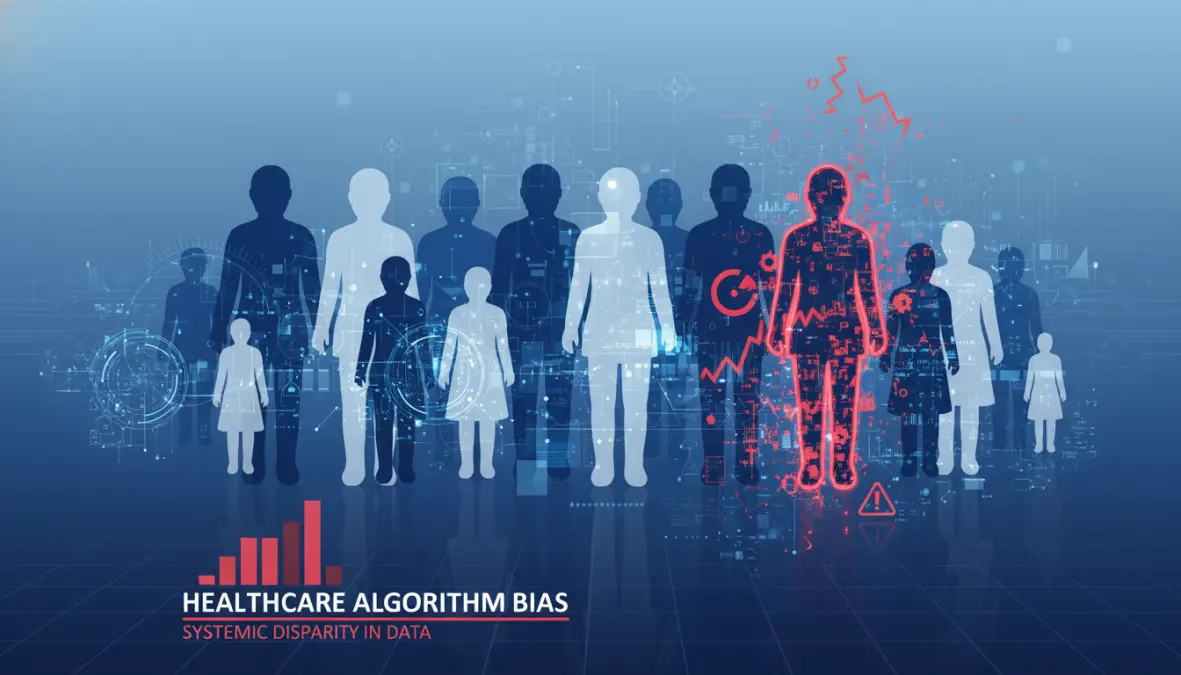
Perhaps the most documented concern in healthcare algorithm bias involves the data these systems learn from. AI is only as good as its training data, and medical datasets have historically underrepresented minorities, women, and economically disadvantaged populations. The consequences can be deadly.
A landmark study revealed that a widely used algorithm for managing chronic illness systematically discriminated against Black patients. The system was less likely to identify Black patients as needing extra care compared to equally sick white patients—affecting millions. Why? The algorithm used healthcare spending as a proxy for illness severity, but Black patients historically have less money spent on their care due to systemic inequities, not because they’re healthier.
Similar biases have emerged in machine learning medicine ethics research. Pulse oximeters, which help COVID-19 patients monitor oxygen levels, work less accurately on people with darker skin. AI diagnostic tools trained primarily on data from one demographic may perform poorly on others. When we ask how to ensure AI healthcare algorithms are ethical, addressing these representation gaps becomes fundamental.
Accountability and Transparency in AI Systems
Here’s where things get legally murky. When considering autonomous medical decisions, the question of who is responsible when AI makes wrong medical decisions doesn’t have clear answers yet. Is it the software developer? The hospital that purchased the system? The clinician who followed its recommendation?
The “black box” problem compounds this issue. Many advanced AI systems, particularly deep learning neural networks, operate in ways that even their creators can’t fully explain. They process thousands of variables through multiple layers to reach conclusions, but the specific reasoning pathway remains opaque. In medicine, where we need to justify every decision—especially life-or-death ones—this lack of explainability is deeply problematic.
Medical liability laws weren’t written with AI in mind. Traditional malpractice frameworks assume human decision-makers whose reasoning can be evaluated. But should AI make life or death decisions in hospitals without physicians being able to understand and challenge its logic? Most ethicists and clinicians say absolutely not, yet we’re already deploying systems that operate as partial black boxes.
Algorithmic transparency has become a rallying cry. Regulators and healthcare advocates increasingly demand “explainable AI”—systems that can show their work, so to speak. But creating transparent AI that’s also highly accurate remains a significant technical challenge.
Finding the Balance: Humans, AI, and Collaborative Decision-Making
The future of artificial intelligence patient care doesn’t have to be an either-or proposition. Rather than asking can artificial intelligence replace doctors ethical implications, we should be asking how humans and AI can work together optimally, with clear ethical guardrails.
The most promising approach is the “human-in-the-loop” model, where clinical decision support systems augment rather than replace physician judgment. In this framework, AI serves as a highly sophisticated second opinion—flagging potential diagnoses a doctor might have missed, suggesting treatment options based on the latest research, or warning about drug interactions. But the final decision, and the accountability, remains with trained medical professionals.
Physician oversight becomes crucial, especially in complex or ambiguous cases. AI might excel at pattern recognition in straightforward scenarios, but medicine frequently involves nuance, uncertainty, and ethical complexity that require human wisdom and empathy. A cancer diagnosis isn’t just about identifying malignant cells—it’s about understanding a patient’s values, quality-of-life preferences, family situation, and countless other human factors that algorithms struggle to process.
Patient autonomy and informed consent must remain central. Patient consent for AI medical treatment decisions isn’t just a box to check—it’s about genuinely informing people when algorithms influence their care. Patients deserve to know if AI is involved, how reliable it is, what its limitations are, and whether they can opt for human-only evaluation instead.
Healthcare data privacy deserves special mention. AI systems require massive amounts of patient data to train and improve. Protecting this sensitive information while allowing beneficial AI development requires robust frameworks that prioritize patient privacy and give individuals control over how their health data is used.
Looking forward, accountability in AI-driven healthcare systems requires policy innovations. Some proposals include mandatory algorithm audits for bias, certification requirements for medical AI similar to FDA drug approvals, and clear liability frameworks. Professional medical societies are developing guidelines, but regulation hasn’t kept pace with technology.
The future of medical AI ethics will likely involve tiered approaches: AI might operate more autonomously in low-risk scenarios (scheduling, routine monitoring) while requiring strict human oversight for high-stakes decisions. Predictive analytics medicine can help identify at-risk patients, but human clinicians should determine interventions. It’s about leveraging AI’s strengths while respecting its limitations and maintaining human moral responsibility.

FAQ: Common Questions About AI Ethics in Healthcare
Can AI replace doctors in making diagnoses?
Not entirely. While AI excels at pattern recognition and can match or exceed human accuracy in specific diagnostic tasks like reading medical images, it lacks the holistic judgment, empathy, and contextual understanding that physicians provide. The most effective approach uses AI to augment—not replace—doctor expertise, combining computational power with human wisdom.
Who is liable if an AI makes a wrong medical decision?
This remains legally ambiguous and varies by jurisdiction. Potential liable parties include the AI developer, the healthcare institution deploying it, and the supervising physician. Current legal frameworks generally hold human clinicians responsible for final decisions, which is why physician oversight of AI recommendations is critical and why purely autonomous medical AI raises serious liability concerns.
How can we ensure AI doesn’t discriminate against certain patient groups?
Ensuring fairness requires diverse, representative training data that includes all demographic groups. Regular bias audits, transparency about algorithm performance across different populations, and diverse development teams help identify problems. Regulatory standards requiring proof of equitable performance before deployment would also address this concern systematically.
Should patients be told when AI is involved in their care?
Yes. Informed consent is a cornerstone of medical ethics, and patients have a right to know how decisions about their health are made. Transparency about AI involvement, its accuracy rates, and any known limitations allows patients to make informed choices and ask questions about their care—strengthening rather than undermining trust.
What regulations exist for medical AI?
Regulatory frameworks are evolving. The FDA regulates some medical AI as medical devices, requiring safety and effectiveness demonstrations before approval. The EU’s AI Act proposes risk-based regulations with strict requirements for high-risk medical applications. However, comprehensive regulations specifically addressing medical AI ethics, accountability, and bias remain works in progress in most jurisdictions.
The intersection of ai ethics healthcare and life-saving decisions represents one of the most consequential conversations of our time. As these technologies become more capable, we must ensure they’re deployed thoughtfully, transparently, and always in service of patient welfare—not convenience or profit. The goal isn’t to stop progress but to steer it wisely, preserving the human elements of medicine while embracing tools that can genuinely save lives. Getting this balance right isn’t just about good technology—it’s about the kind of healthcare system, and society, we want to build.