Nuclear Fusion Breakthrough: How ITER Is Leading the Race to Commercial Fusion Energy
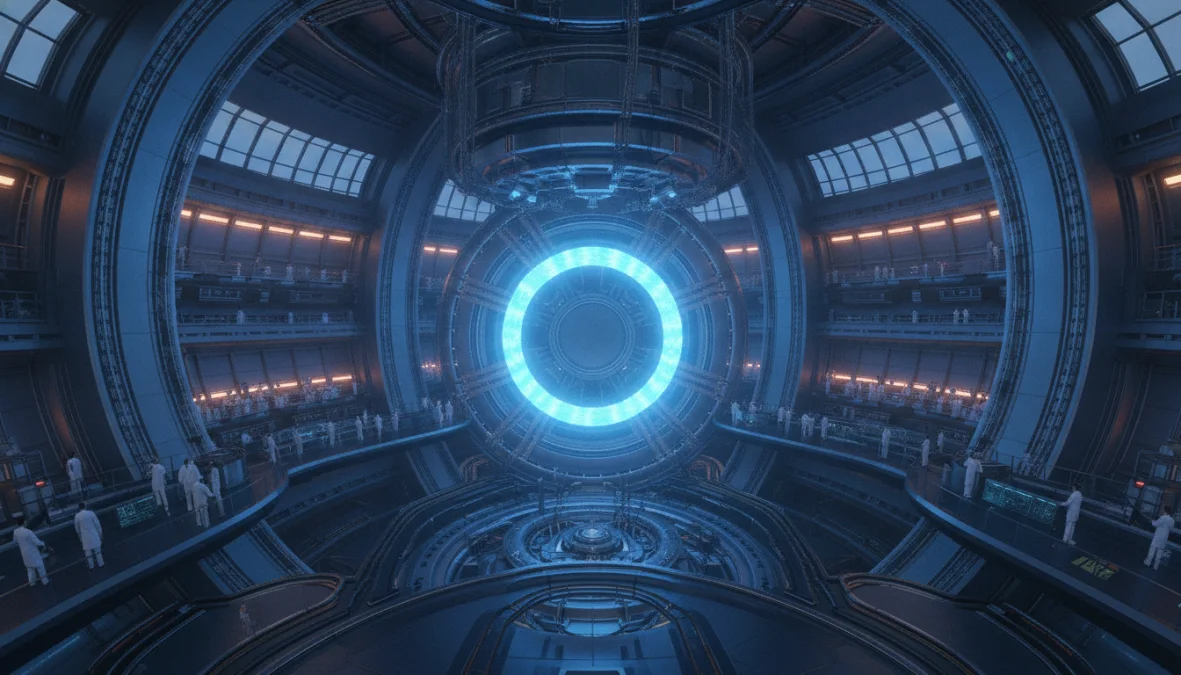
Imagine an energy source so powerful it could light up entire cities, so clean it produces virtually no carbon emissions, and so abundant its fuel could be extracted from seawater. Sound like science fiction? Not anymore. The nuclear fusion breakthrough we’ve been waiting for is finally within reach, and ITER—the world’s most ambitious energy project—is leading the charge toward making commercial fusion energy a reality.
While the world grapples with climate change and energy security, scientists and engineers across 35 nations are collaborating on something that could transform civilization as we know it. Let’s dive into how ITER is turning the decades-old dream of fusion power into an engineering marvel that might just save our planet.
Understanding the Nuclear Fusion Breakthrough: Why ITER Matters
At its core, nuclear fusion energy is the process that powers the sun and stars. Unlike nuclear fission—which splits heavy atoms apart and produces dangerous long-lived radioactive waste—fusion smashes light atoms together to create heavier ones, releasing massive amounts of energy in the process. It’s the ultimate clean energy dream: abundant fuel, minimal waste, and zero carbon emissions.
Here’s why fusion has earned its reputation as the ‘holy grail’ of energy: deuterium, one of fusion’s primary fuels, can be extracted from ordinary seawater. There’s enough deuterium in Earth’s oceans to power human civilization for millions of years. The other fuel, tritium, can be bred from lithium—another abundant element. The main byproduct? Helium gas, which is completely harmless.
Enter the ITER project, the International Thermonuclear Experimental Reactor. This isn’t just another research facility—it’s the culmination of decades of fusion research and represents humanity’s best shot at proving fusion can work at industrial scale. ITER’s goal is deceptively simple yet monumentally challenging: achieve a Q factor greater than 10, meaning it will produce ten times more energy than it consumes to initiate the fusion reaction.
The breakthrough represented by tokamak technology at ITER is that it uses powerful magnetic fields to contain plasma heated to over 150 million degrees Celsius—ten times hotter than the sun’s core. At these extreme temperatures, hydrogen isotopes overcome their natural repulsion and fuse together, releasing energy. If ITER succeeds, it will demonstrate that fusion power isn’t just theoretically possible—it’s practically achievable.
The ITER Project: Building the World’s Largest Fusion Reactor
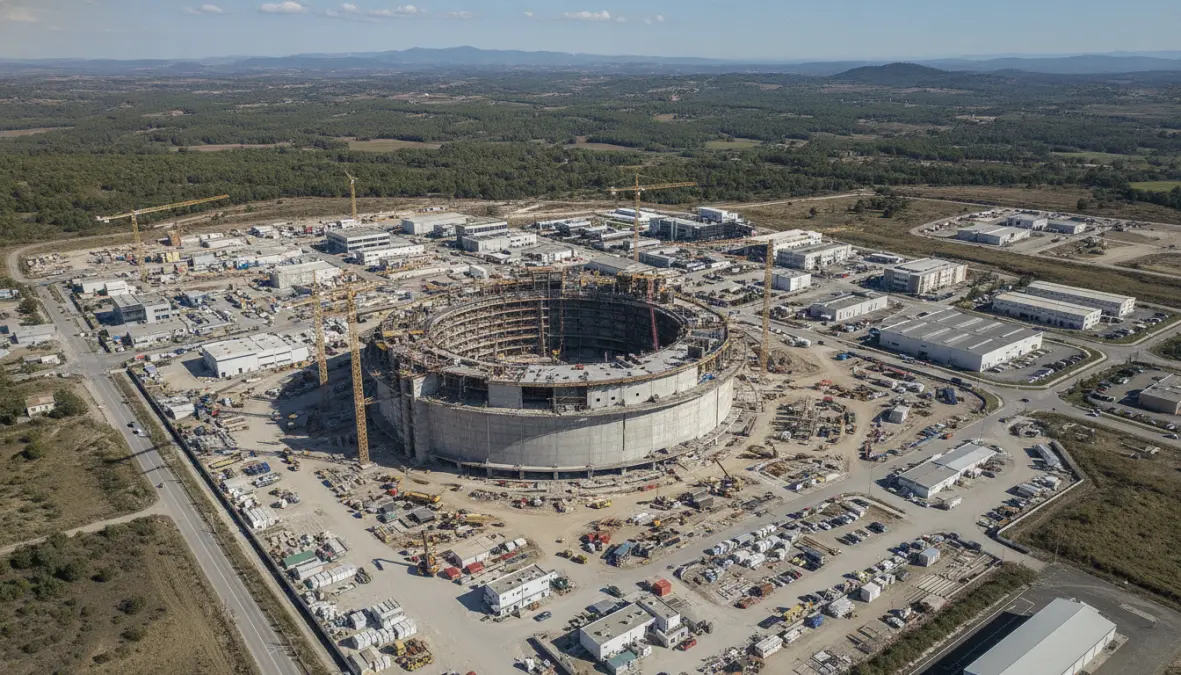
Located in Saint-Paul-lès-Durance in southern France, the ITER project represents the largest scientific collaboration in history. With 35 participating nations including the European Union, United States, China, Russia, Japan, India, and South Korea, ITER pools together roughly half of the world’s population and GDP toward a single goal: proving that commercial fusion energy is achievable.
The scale of this fusion reactor is staggering. The tokamak chamber stands ten stories tall and weighs 23,000 tons—heavier than three Eiffel Towers. Its massive superconducting magnets must operate at temperatures near absolute zero while containing plasma that’s hotter than any naturally occurring substance in our solar system. The entire facility occupies 180 hectares, and construction involves precision engineering challenges that make building a spacecraft look simple.
Current construction progress shows the facility is approximately 80% complete. The timeline for when will ITER achieve fusion projects first plasma operations beginning around 2025-2026, with full deuterium-tritium fusion experiments expected in the 2030s. These aren’t arbitrary dates—every component must be manufactured to tolerances measured in millimeters despite the massive scale, then assembled with exacting precision.
The engineering challenges are mind-boggling. ITER’s superconducting magnets must generate magnetic fields strong enough to suspend and compress the plasma without physically touching it—because no material on Earth can withstand direct contact with 150-million-degree temperatures. The reactor’s first wall must absorb neutrons traveling at one-sixth the speed of light, while cooling systems circulate 15,000 cubic meters of water to prevent the entire structure from melting.
How Tokamak Technology Powers the Fusion Reaction
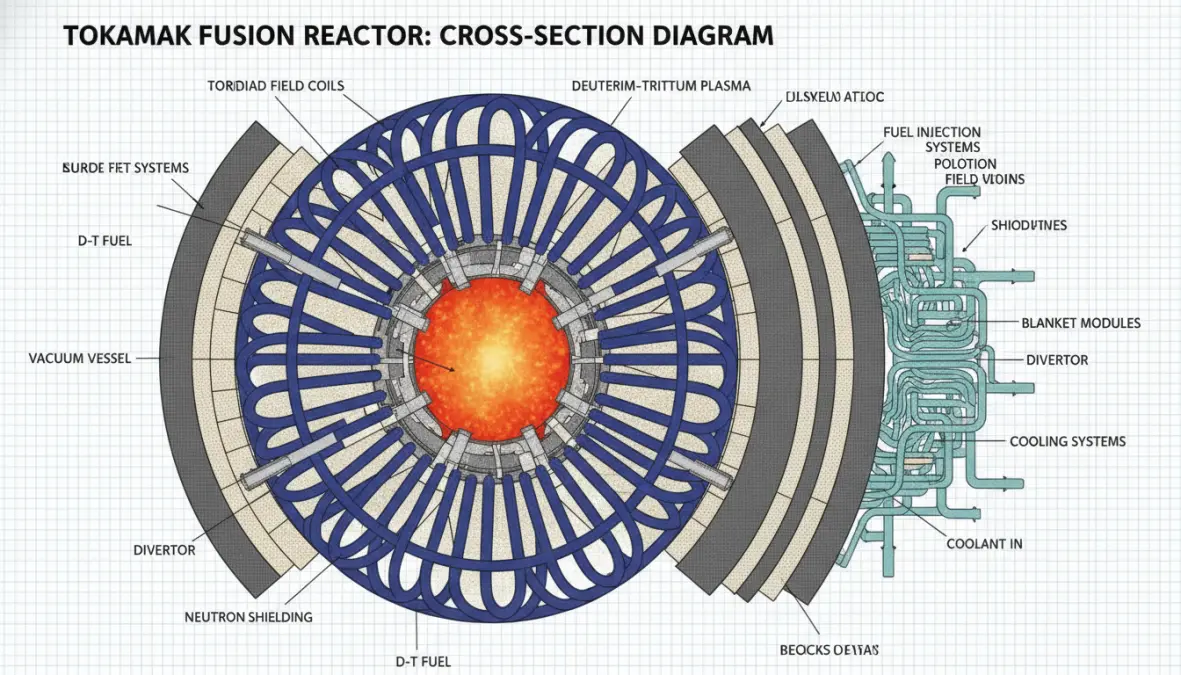
So how does ITER fusion reactor work? The tokamak design uses a donut-shaped chamber where powerful electromagnetic coils create a magnetic ‘cage’ that suspends superheated plasma away from the reactor walls. Inside this magnetic confinement fusion environment, deuterium and tritium atoms collide at extreme velocities, their nuclei fusing to create helium and releasing high-energy neutrons.
This deuterium tritium reaction is the easiest fusion reaction to achieve because it requires the lowest temperature—though ‘lowest’ still means 150 million degrees Celsius. Plasma confinement is the critical challenge: the plasma must be dense enough and stable enough for long enough that fusion reactions occur more frequently than the energy being pumped in to maintain the temperature.
The magnetic confinement fusion approach used by ITER’s tokamak differs from other designs like the stellarator, which uses more complex twisted magnetic field geometries. Tokamaks are simpler conceptually but require pulsed operation, while stellarators could theoretically run continuously but are much harder to build.
From Breakthrough to Reality: The Path to Commercial Fusion Energy
ITER’s mission is to prove fusion works—but it’s not designed to be a power plant. The real fusion power breakthrough will come when someone takes ITER’s lessons and builds the first commercial reactor that feeds electricity into the grid. This transition from experimental science to commercial fusion energy is where things get interesting, and competitive.
Private companies are racing to beat ITER to commercialization. Commonwealth Fusion Systems, backed by MIT, is building a compact tokamak called SPARC that aims to achieve net energy gain sooner than ITER by using newer high-temperature superconductors. TAE Technologies pursues a different approach entirely, while General Fusion in Canada is developing magnetized target fusion. These ITER vs private fusion companies comparisons aren’t entirely fair—private efforts build on decades of publicly funded research that ITER represents—but they demonstrate growing confidence that fusion is finally achievable.
The advantages of clean energy fusion are compelling enough to drive this investment boom. Fusion produces no carbon emissions during operation, making it crucial for climate goals. Unlike fission, fusion reactions can’t melt down—if anything goes wrong, the plasma simply cools and fusion stops. There’s no long-lived radioactive waste requiring storage for thousands of years. And the fuel supply is essentially limitless, which means energy security for nations that embrace it.
However, significant challenges remain before fusion becomes commercially viable. Current reactor designs are enormously expensive—ITER’s price tag exceeds $20 billion. Materials must withstand years of neutron bombardment without degrading. Most challenging is achieving true fusion ignition where the reaction becomes self-sustaining, requiring only initial input energy. The National Ignition Facility achieved this milestone through inertial confinement fusion recently, but scaling it to grid-level power production remains distant.
Realistically, the commercial fusion energy timeline extends into the 2040s at the earliest. ITER will provide crucial data throughout the 2030s, and the next-generation demonstration plant called DEMO will build on those results. Private companies may accelerate this timeline, but fusion has famously been ‘thirty years away’ for seventy years. The difference now? We’re actually building reactors at scale and achieving the physics milestones necessary for success. Similar to how nations are reconsidering nuclear options overall, as discussed in the nuclear energy comeback, fusion represents the next evolution in clean atomic power.
FAQ: Nuclear Fusion and ITER
What is the latest nuclear fusion breakthrough?
The National Ignition Facility achieved fusion ignition in late 2022, demonstrating that fusion reactions can produce more energy than directly applied to the fuel. Meanwhile, ITER project construction continues progressing toward first plasma, and private companies have announced increasingly ambitious timelines for pilot fusion plants.
When will ITER start producing energy?
ITER will begin initial plasma experiments around 2025-2026, but full deuterium-tritium fusion operations producing significant energy won’t occur until the 2030s. ITER is designed as a research reactor to prove fusion feasibility rather than generate grid electricity.
Is fusion energy really clean and safe?
Yes. Clean energy fusion produces no carbon emissions, cannot experience runaway meltdown reactions, and generates minimal radioactive waste compared to fission. The main waste product is helium, and while reactor components become radioactive from neutron exposure, they’re manageable compared to fission’s centuries-long waste storage requirements.
How close are we to commercial fusion power?
Most experts predict commercial fusion energy won’t reach electrical grids until the 2040s or 2050s, though private companies claim earlier timelines. ITER will provide crucial data throughout the 2030s, informing the next generation of demonstration and commercial reactors. The question has shifted from ‘if’ to ‘when.’
The journey toward fusion energy mirrors other massive technological leaps humanity has undertaken, from the new space race to groundbreaking research in longevity science—ambitious goals requiring decades of patient investment before paying dividends. ITER’s nuclear fusion breakthrough won’t solve our energy problems tomorrow, but it’s building the foundation for an energy-abundant future where climate concerns from power generation become relics of the past. Whether ITER or a private company crosses the finish line first, humanity wins.