Direct Air Capture Technology: How Machines Remove CO2 from the Atmosphere
Imagine a giant vacuum cleaner that sucks carbon dioxide straight out of the sky. Sounds like science fiction, right? Well, direct air capture technology is making this a reality. As we grapple with rising greenhouse gas levels and the urgent need for climate change mitigation, these innovative CO2 removal machines are emerging as a crucial tool in our environmental toolkit. While reducing emissions remains our top priority, direct air capture offers something different: the ability to reverse past damage by pulling carbon dioxide directly from the atmosphere, no matter where it was originally released.
What Is Direct Air Capture and How Does It Work?
Direct air capture, or DAC technology, is exactly what it sounds like: a process that captures carbon dioxide directly from ambient air. Unlike traditional carbon capture technology that grabs CO2 from concentrated sources like power plant smokestacks (known as point source capture), DAC machines can be placed anywhere on Earth and will still work their magic. This makes atmospheric carbon removal incredibly flexible compared to other carbon sequestration methods.
So how does direct air capture work? Think of it like a super-selective air purifier. The process uses chemical reactions to grab CO2 molecules from the air, separate them out, and then release the cleaned air back into the atmosphere. There are two main approaches currently in use:
- Solid sorbent systems: These use solid materials (often containing amines) that bind with CO2 when air passes through. Once saturated, they’re heated to release the concentrated CO2, and the material regenerates for reuse.
- Liquid solvent systems: These spray a liquid solution (typically hydroxide) that chemically reacts with CO2. The resulting compound is then processed to extract pure CO2 and regenerate the solution.
Here’s a simple analogy: imagine a sponge that only absorbs one specific color of paint from a mixed palette. DAC systems are like chemical sponges that selectively grab CO2 molecules from air that’s roughly 0.04% carbon dioxide, concentrate it, squeeze it out, and get ready to do it all over again. The captured CO2 can then be permanently stored underground or used in products—contributing to carbon neutrality and net zero emissions goals.
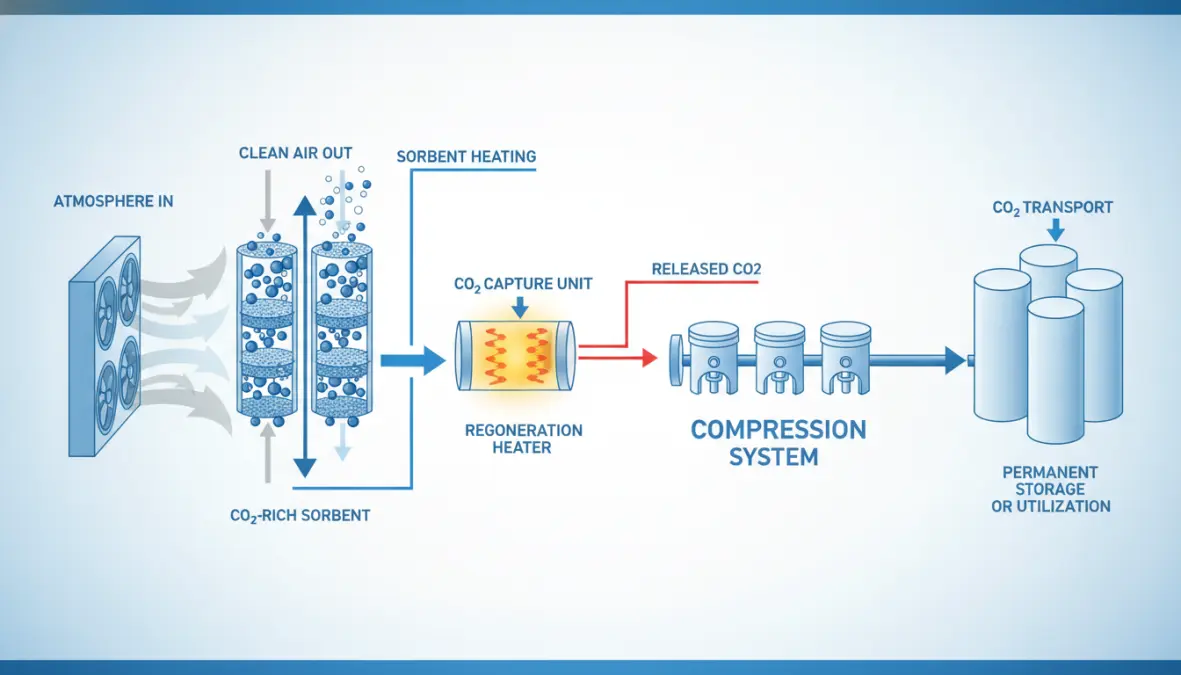
How Direct Air Capture Technology Removes Carbon Dioxide
The Carbon Capture Process: From Air to Storage
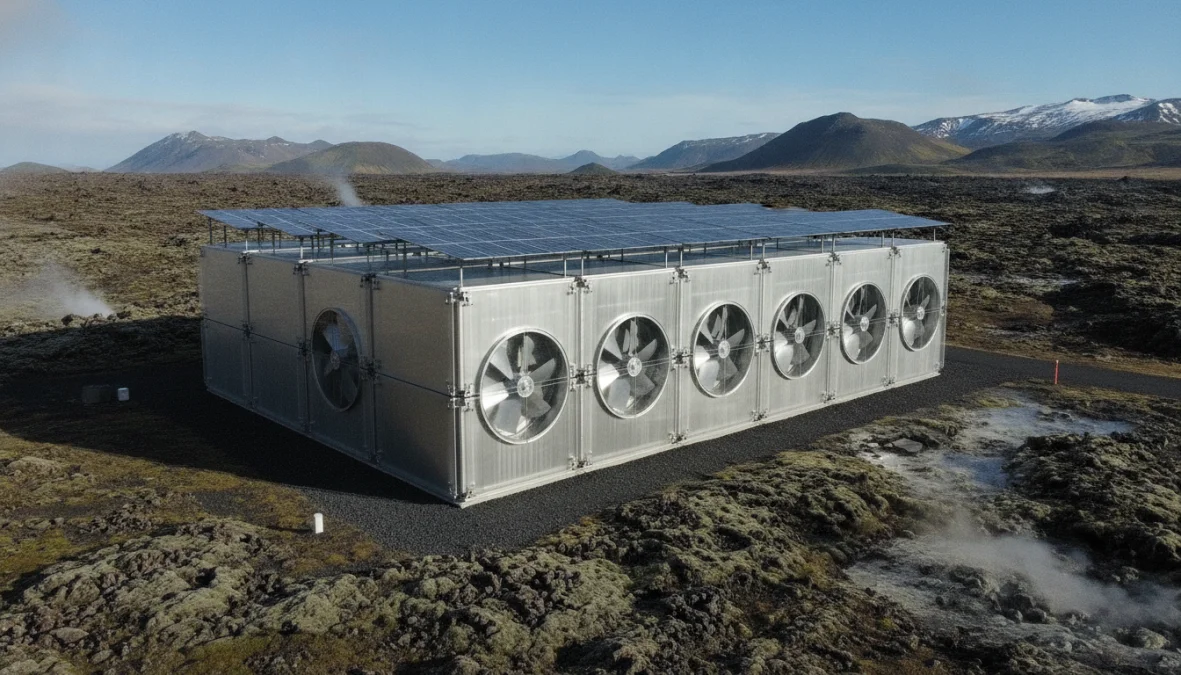
The journey of a CO2 molecule through a CO2 removal machine involves several carefully orchestrated steps. First, giant fans draw massive volumes of ambient air into the system—we’re talking thousands of cubic meters per hour. This is the most energy-intensive part of air filtration carbon processes.
Once inside, the air contacts the capture material (either solid sorbent or liquid solvent), where CO2 molecules stick while other gases pass through freely. After the material becomes saturated, the system switches to regeneration mode. Heat is applied—typically between 80-120°C for solid sorbents or higher for liquid systems—causing the captured CO2 to release in concentrated form.
The pure CO2 stream is then compressed into a liquid or supercritical state for easier handling. Finally, it’s either permanently stored in geological formations deep underground (true carbon sequestration) or used in commercial applications like making concrete, synthetic fuels, or carbonated beverages. This end-to-end process is what makes DAC a genuine negative emissions technology—it actually removes carbon from the atmosphere rather than just preventing new emissions.
Current DAC Facilities and Real-World Applications
The most prominent player in commercial direct air capture facilities worldwide is Climeworks, a Swiss company operating multiple plants. Their Orca facility in Iceland, launched in partnership with Carbfix, captures 4,000 tonnes of CO2 annually and injects it into basalt rock formations where it mineralizes permanently. They’ve since scaled up with Mammoth, designed to capture 36,000 tonnes yearly.
Carbon Engineering, a Canadian firm backed by major investors, has developed liquid-solvent DAC technology and is building a massive facility in Texas with Occidental Petroleum capable of removing one million tonnes of CO2 per year. Meanwhile, companies like Microsoft, Stripe, and Shopify are purchasing carbon credits from these operations, creating a business model that helps offset their corporate emissions while funding the technology’s growth.
Currently, all operational DAC plants combined remove only about 10,000 tonnes of CO2 annually—a drop in the bucket compared to the 40 billion tonnes humanity emits each year. But as direct air capture companies and projects multiply and technology improves, this capacity is expected to grow exponentially over the coming decades.
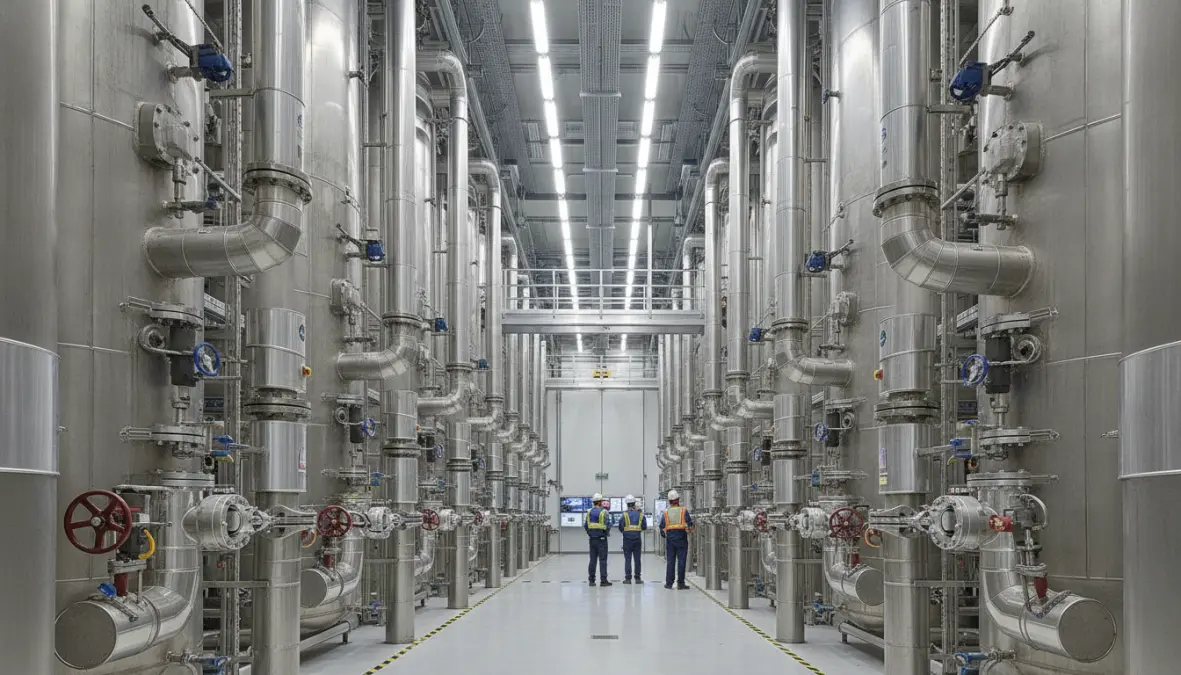
Challenges, Costs, and Future Potential of Direct Air Capture
Let’s be honest: the cost of direct air capture technology is eye-watering. Current estimates range from $600 to $1,000 per tonne of CO2 removed, making it far more expensive than preventing emissions in the first place. To put this in perspective, traditional tree-planting programs typically cost $10-50 per tonne of CO2 sequestered over a tree’s lifetime.
The biggest expense? Energy. Direct air capture efficiency and energy requirements are intrinsically linked, and the process demands enormous amounts of power—both electricity to run fans and heat to regenerate capture materials. If this energy comes from fossil fuels, the technology could actually create more emissions than it removes, defeating its entire purpose. That’s why most facilities locate near renewable energy sources or use waste heat from geothermal or industrial processes.
When comparing direct air capture vs carbon capture and storage at emission sources, point source capture wins on cost and efficiency because it deals with concentrated CO2 streams. However, DAC’s superpower is flexibility—it can address emissions from diffuse sources like agriculture and transportation that are impossible to capture at the source.
The good news? Costs are projected to drop dramatically. The U.S. Department of Energy has set a goal to bring costs below $100 per tonne, and experts believe this is achievable through technological improvements, economies of scale, and manufacturing innovations. Government support is growing too, with tax credits and direct funding programs accelerating development. Just as solar panel costs plummeted 90% over a decade, similar trajectories are possible for DAC.
As for atmospheric carbon removal contributing to net zero emissions, we need realistic expectations. DAC isn’t a silver bullet that lets us keep polluting. It’s a complement to aggressive emissions reductions—a tool for mopping up hard-to-eliminate emissions and potentially reversing historical damage. Scientists estimate we’ll need to remove billions of tonnes annually by mid-century to meet climate goals, requiring a scale-up of many orders of magnitude from today’s capacity. Much like how companies are rethinking traditional work structures through initiatives like the four-day work week, the climate technology sector is reimagining what’s possible with carbon removal.
FAQ: Direct Air Capture Technology
Is direct air capture better than planting trees?
Not necessarily “better,” but different. Trees are cheaper and provide ecosystem benefits, but they require land, water, and decades to sequester carbon. DAC works anywhere, captures CO2 faster, and offers permanent storage. Both approaches are needed—nature-based solutions and carbon capture technology working together for maximum impact.
How much does DAC cost?
Current CO2 removal machines cost $600-1,000 per tonne of CO2 captured, though this varies by facility and method. Costs are expected to drop below $100 per tonne within the next decade as technology matures and deployment scales up, making it economically competitive with other carbon offset technology solutions.
Can direct air capture reverse climate change?
DAC alone cannot reverse climate change, but it’s a critical piece of the puzzle. We must drastically cut emissions first. Then, negative emissions technology like DAC can help remove legacy carbon and offset unavoidable emissions from sectors like aviation, helping achieve true climate stabilization over time.
What happens to captured CO2?
Captured carbon dioxide follows two paths: permanent geological storage deep underground in rock formations (true carbon sequestration), or utilization in products like building materials, synthetic fuels, or chemicals. Storage is preferable for climate goals, while utilization creates revenue streams that help fund the technology’s expansion.
The road ahead for direct air capture is challenging but promising. As costs fall, capacity grows, and clean energy becomes ubiquitous, these remarkable machines could become as common as wind turbines in our quest for carbon neutrality. The question isn’t whether we’ll need this technology—it’s how quickly we can make it affordable and scalable enough to matter.