The Longevity Dividend: How Extending Healthy Lifespan Drives Economic Growth

Imagine a world where people not only live longer but remain vibrant, productive, and healthy well into their 80s and 90s. This isn’t just a feel-good scenario—it represents one of the most significant economic opportunities of our time. The longevity dividend describes the substantial economic benefits that society gains when we successfully extend not just lifespan, but healthspan—the period of life spent in good health. As our understanding of biomedical gerontology advances, we’re discovering that investing in healthy aging economics isn’t just compassionate policy; it’s smart economics.
What Is the Longevity Dividend?
The longevity dividend refers to the economic, social, and health benefits that arise when scientific research successfully extends the period of healthspan extension—meaning the years we live in good health, free from chronic disease and disability. This concept fundamentally challenges the assumption that an aging population inevitably drains economic resources.
To understand this, we need to distinguish between lifespan and healthspan. Lifespan is simply how long you live, while healthspan is how long you live well. Currently, many people experience a significant gap between these two: they may live into their 80s, but spend the last 10-15 years managing multiple chronic conditions, requiring extensive medical care, and unable to work or fully participate in society.
This is where the concept of compression of morbidity becomes crucial. Coined by Stanford researcher James Fries, compression of morbidity means reducing the period of illness and disability at the end of life. Instead of a gradual 15-year decline, imagine remaining healthy and active until 85, then experiencing a brief period of illness before death. This compression dramatically reduces the chronic disease burden and associated healthcare costs while maximizing quality-adjusted life years.
The central thesis of healthy aging economics is powerful: investing in longevity research and age-related disease prevention generates economic returns that far exceed the initial investment. When we delay or prevent diseases like Alzheimer’s, cardiovascular disease, and diabetes—rather than just treating them—we create enormous economic value while improving countless lives. Recent longevity science breakthroughs are making this vision increasingly achievable.
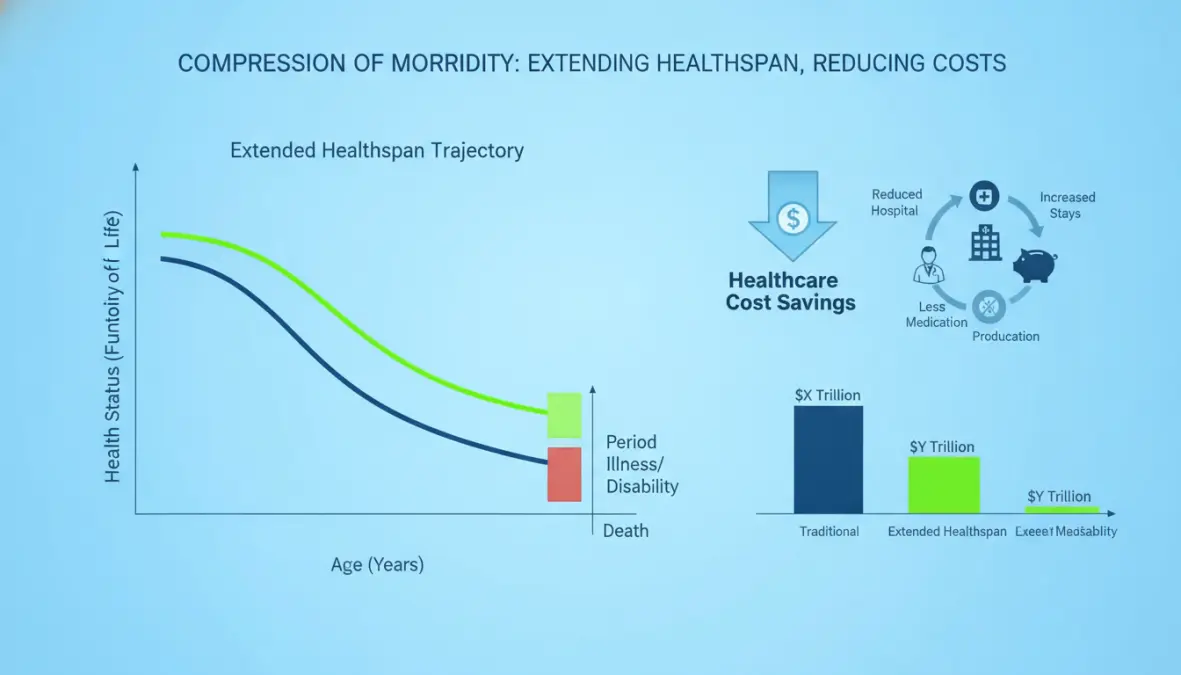
Economic Benefits of an Aging Population with Extended Healthspan
The economic impact of longevity when coupled with extended healthspan is multifaceted and substantial. Rather than viewing aging populations as economic burdens, we should recognize the aging population benefits that emerge when people remain healthy longer. The longevity economy represents a fundamental shift in how we think about aging and economic productivity.
Here are the primary economic benefits of extending healthy lifespan:
- Massive healthcare expenditure reduction through prevention rather than expensive late-life treatments for chronic conditions
- Extended workforce participation as healthy older adults continue contributing their skills, experience, and productivity
- Increased tax revenues from people who work additional productive years rather than entering early retirement due to health issues
- Reduced pension system strain as the ratio of workers to retirees improves and people delay retirement
- Robust consumer spending from healthy seniors who travel, pursue hobbies, and maintain active lifestyles
- Growth of new economic sectors focused on enhancing and supporting healthy aging
- Innovation acceleration as experienced professionals continue contributing to research, mentorship, and knowledge transfer
Some estimates suggest that extending healthy lifespan by just one year could generate economic value in the trillions of dollars globally. The economic benefits of extending healthy lifespan compound over time, creating a positive feedback loop where healthier populations generate more wealth, which can be reinvested in further health improvements.
The Healthcare Cost Reduction Potential
The potential for healthcare expenditure reduction through compression of morbidity is staggering. Currently, a disproportionate amount of lifetime healthcare spending occurs in the final years of life, often managing multiple chronic conditions simultaneously. In many developed countries, the last year of life accounts for 10-12% of total healthcare spending.
Consider the cost savings from preventing chronic diseases: Type 2 diabetes costs the U.S. healthcare system over $300 billion annually. Alzheimer’s and related dementias cost over $300 billion. Cardiovascular disease exceeds $200 billion. If longevity research could delay the onset of these conditions by even 5-7 years, the economic savings would be enormous—potentially reducing geriatric care costs by hundreds of billions annually.
The economic value of delaying age-related diseases extends beyond direct medical costs. It includes reduced caregiver burden (often forcing family members to leave the workforce), decreased need for long-term care facilities, and maintained independence that preserves quality of life while reducing expensive interventions.
Productive Aging and Workforce Contributions
Productive aging recognizes that healthy older adults represent valuable economic assets. The longevity economy benefits from their continued contributions through traditional employment, consulting roles, entrepreneurship, and knowledge transfer that would otherwise be lost.
The productivity gains from healthy aging population manifest in multiple ways: experienced workers mentoring younger colleagues, senior entrepreneurs starting businesses (people over 50 are nearly twice as likely to found successful companies as those under 30), skilled professionals extending careers in high-value fields, and volunteers providing services that would otherwise require paid labor.
When people remain healthy, they maintain the cognitive function, energy, and motivation to contribute meaningfully. This isn’t about forcing people to work longer out of necessity, but rather enabling those who wish to remain engaged and productive to do so without health limitations forcing premature retirement.

Why Longevity Research Investment Makes Economic Sense
Despite the compelling case for the longevity dividend, longevity research investment remains relatively underfunded compared to its potential returns. The question isn’t whether we can afford to invest in longevity research—it’s whether we can afford not to.
The financial returns on longevity research dramatically exceed the initial investment. Some economic analyses suggest that extending healthy lifespan produces returns measured in the thousands of percent. Compare this to the relatively modest funding currently directed toward fundamental aging research and biomedical gerontology, and the opportunity becomes clear.
Promising research areas include senolytic drugs that clear senescent cells, compounds like rapamycin and metformin that show lifespan extension in animal models, NAD+ boosters that support cellular energy metabolism, and cellular reprogramming techniques that may reverse aspects of aging. These approaches target aging itself rather than individual diseases—a more efficient strategy for achieving compression of morbidity.
Some countries and institutions are beginning to recognize this opportunity. Singapore has invested significantly in aging research infrastructure, while private foundations and biotech companies are increasingly funding longevity-focused studies. However, public funding for aging research remains a fraction of what’s spent treating age-related diseases after they develop.
The case for prioritizing preventive medicine and longevity research in public policy is overwhelming. The societal benefits of longer healthy life extend beyond economics to include reduced suffering, maintained independence, and the preservation of wisdom and experience that benefits entire communities. As our understanding of the mechanisms of aging improves, the potential for meaningful interventions grows—but only if we invest in the research necessary to translate scientific insights into practical applications.
The longevity dividend represents a rare opportunity: an investment that simultaneously improves quality of life, reduces suffering, and generates substantial economic returns. As policymakers and societies grapple with the challenges of aging populations, shifting focus from managing decline to extending healthspan offers a path forward that benefits everyone. The economic logic is clear—now we need the collective will to make it happen.