Financial Literacy Gender Gap: Why Women Still Lag Behind in Money Management

Picture this: you’re at a dinner party, and someone brings up investing or retirement planning. Who’s more likely to change the subject or admit they “don’t really get that stuff”? If you guessed women, you’d be statistically correct—and that’s a problem. The financial literacy gender gap isn’t just about numbers on a spreadsheet; it’s about real women facing economic vulnerability, missed opportunities, and delayed retirements. Despite making up nearly half the workforce, women consistently score lower on financial literacy assessments worldwide, and the consequences ripple through every aspect of their financial lives.
Understanding the Financial Literacy Gender Gap
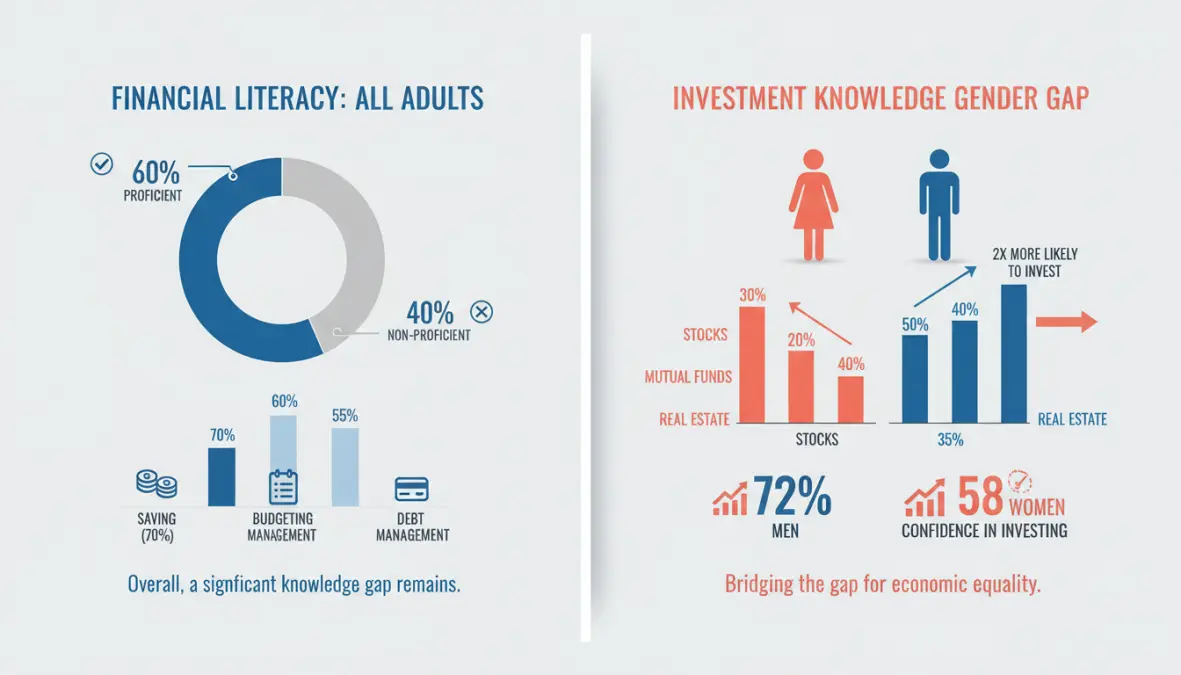
The financial literacy gender gap refers to the measurable difference between men and women’s understanding of fundamental financial concepts like compound interest, inflation, risk diversification, and investment principles. And it’s not a small difference—we’re talking about a consistent, global pattern that shows up across age groups, education levels, and income brackets.
According to the OECD’s international surveys, women financial literacy scores lag behind men’s by an average of 10-15 percentage points across developed nations. But here’s where it gets really interesting: the gender differences financial literacy aren’t uniform across all topics. Women tend to score comparably on basic budgeting and savings questions, but the gap widens dramatically when it comes to investing, stock market knowledge, and retirement planning—precisely the areas that build long-term wealth.
Financial literacy is typically measured through surveys testing knowledge in five key areas: numeracy, interest compounding, inflation, risk diversification, and understanding of financial products. Studies consistently show that women are also more likely to answer “I don’t know” rather than guess, which some researchers argue might reflect genuine caution rather than actual ignorance. However, when we look at real-world behaviors—like investment knowledge application, portfolio diversification, and retirement planning preparedness—the gaps translate into tangible disadvantages that compound over decades.
Root Causes: Why Women Face Greater Financial Challenges
Understanding the gender gap money management requires digging into decades of sociocultural conditioning, economic realities, and systemic barriers. It’s not that women are inherently worse with money—far from it. Instead, they face a perfect storm of factors that limit their exposure to, confidence in, and opportunities for building financial expertise.
First, there’s the educational divide that starts surprisingly early. Traditional gender roles have historically positioned men as breadwinners and financial decision-makers, while women were steered toward domestic responsibilities. Even today, studies show that parents are more likely to discuss investing and stock markets with sons than daughters. This early exclusion from financial education women receive means many women enter adulthood without the foundational knowledge their male peers take for granted.
Then there’s the harsh reality of the wage gap. When women earn approximately 82 cents for every dollar men earn, they simply have less disposable income to invest and experiment with. Lower earnings mean smaller emergency funds, less capacity to take investment risks, and reduced contributions to retirement accounts—all of which limit hands-on learning opportunities that build financial competency.
Career interruptions for caregiving create another massive barrier. Women are far more likely to take time off or reduce work hours to care for children or aging parents. These gaps don’t just reduce lifetime earnings; they also disconnect women from workplace financial benefits, pension contributions, and the professional networks where informal financial knowledge often spreads. A woman who steps out of the workforce for five years isn’t just losing five years of income—she’s losing five years of financial learning and wealth accumulation.
The finance industry itself hasn’t helped. With fewer female role models in investment banking, wealth management, and financial planning, women lack relatable mentors who understand their specific challenges. When financial services are overwhelmingly designed and marketed by men for men, is it any wonder that many women feel like outsiders looking in?
The Confidence Crisis in Women and Money
Perhaps the most insidious aspect of the financial literacy gender gap is the confidence gap. Research from institutions like Vanguard and Fidelity shows that even when women demonstrate equal or superior financial decision making skills (women investors often outperform men due to more disciplined, less impulsive strategies), they consistently rate their own women financial confidence significantly lower than men rate theirs.
This isn’t just modesty—it’s impostor syndrome applied to money. Women are more likely to second-guess investment decisions, delay entering the market until they feel “ready” (spoiler: that perfect moment rarely comes), and defer to male partners or advisors even when they have solid financial knowledge themselves. Studies show that women require higher levels of knowledge before feeling confident enough to make financial moves, while men often charge ahead with less information but more self-assurance.
This confidence crisis has real consequences. Lower confidence translates to lower risk tolerance, which often means more conservative investment portfolios that generate smaller returns over time. It means women are less likely to negotiate salaries aggressively or ask for raises. And perhaps most concerning, it means many women completely avoid money management skills development because they’ve internalized the message that “finance isn’t for me.” Much like the patterns we see with doomscrolling behaviors where we fall into habitual patterns that reinforce negative feelings, women can get trapped in cycles of financial avoidance that perpetuate the gap.

Closing the Gap: Solutions for Better Women’s Financial Education
Closing financial literacy gap requires action on multiple fronts—from individual initiative to institutional reform. The good news? There’s growing recognition of the problem and increasing resources dedicated to solving it.
At the individual level, women can take concrete steps to improve their women investing knowledge. Start with the basics: understand your current financial situation, learn the fundamentals of compound interest and diversification, and set specific financial goals. Online platforms like Ellevest, HerMoney, and The Female Investor offer financial education women content that addresses specific challenges and questions women face, without the condescension or jargon overload.
Investment clubs and peer learning groups specifically for women have proven remarkably effective. When women learn about money in supportive environments where “stupid questions” don’t exist, confidence grows alongside competence. Organizations like Bravely Go and Smart Women Securities provide community-based learning that normalizes financial discussions among women.
Workplace programs represent another crucial intervention point. Companies can offer financial empowerment programs that provide education on salary negotiation, retirement planning, stock options, and investment strategies. When employers specifically design programs acknowledging that women may have different starting points and concerns—like managing career breaks or planning for longer lifespans—engagement and outcomes improve dramatically.
On the policy front, we need educational reform that incorporates financial literacy into standard curriculum earlier and ensures equal exposure for all genders. Countries like Australia and New Zealand that have implemented mandatory financial education in schools show promising results in narrowing gender gaps among younger generations.
Financial services firms themselves need to do better. This means hiring more women advisors, designing products that address women’s specific needs (like longer retirement horizons), and eliminating the patronizing marketing that still treats women as financial novices who need everything explained in terms of shoes and shopping. Women don’t need finance “pink-ified”—they need it demystified.
Perhaps most importantly, we need to change the conversation around economic independence. Financial literacy isn’t about becoming a day-trader or memorizing stock tickers—it’s about having the knowledge and confidence to make informed decisions about your money, your future, and your security. When we frame financial education as essential life skills rather than optional expertise, more women will engage.
FAQ: Common Questions About the Financial Literacy Gender Gap
What is the main cause of the financial literacy gender gap?
There’s no single cause—it’s a combination of factors including traditional gender roles that excluded women from financial discussions, the wage gap limiting investment opportunities, career interruptions for caregiving, lack of female role models in finance, and confidence gaps that discourage women from engaging with financial topics even when they have the knowledge.
Are women worse at managing money than men?
Absolutely not. Studies actually show that women investors often achieve better returns than men because they trade less frequently, maintain more disciplined strategies, and take more time researching decisions. The gap is in knowledge and confidence, not in actual ability or performance when women do engage with investing.
How can women improve their financial literacy?
Start with free online resources and courses focused on basics like budgeting, understanding compound interest, and retirement planning. Join women-focused investment groups or forums, consider working with a fee-only financial advisor, read personal finance books, and most importantly, start putting knowledge into practice with small investment amounts to build confidence alongside competence.
Does the gender pay gap contribute to financial literacy differences?
Yes, significantly. Lower earnings mean women have less disposable income to invest and learn from real-world experience. The wage gap also reduces contributions to retirement accounts and limits the resources available for taking calculated risks—all of which reduce opportunities to develop hands-on financial knowledge.
What countries have the largest financial literacy gender gap?
The gap tends to be largest in countries with more traditional gender roles and less gender equality overall. Research shows particularly wide gaps in parts of Asia, the Middle East, and some Southern European countries, while Nordic nations with stronger gender equality policies show smaller disparities—though gaps exist everywhere.
The financial literacy gender gap isn’t just a women’s issue—it’s an economic issue that affects families, communities, and entire economies. When half the population lacks the knowledge and confidence to build wealth, negotiate effectively, and plan for secure retirements, everyone loses. But here’s the empowering truth: financial literacy is a skill, not an innate talent. It can be learned, practiced, and mastered at any age or stage. The first step is simply deciding that your financial education matters—because it absolutely does.