The Creativity Crisis: Why Divergent Thinking Skills Are Declining Worldwide
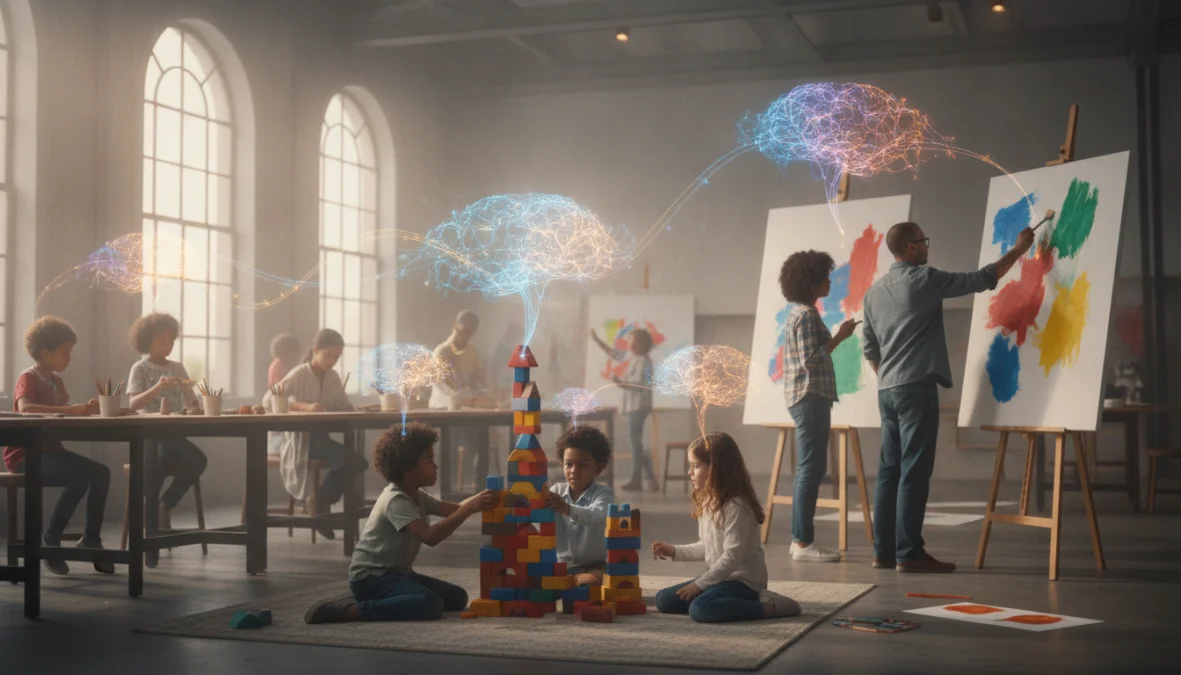
Remember when you could spend hours building elaborate worlds out of cardboard boxes, or when a simple stick could become a sword, a wand, or a spaceship? That natural creative spark seems to be fading across generations. Research shows a troubling trend: our collective ability to think creatively is declining at an alarming rate. This isn’t just about fewer finger paintings on refrigerators—the creativity crisis represents a fundamental shift in how our brains approach problems, generate ideas, and imagine possibilities.
What Is the Creativity Crisis and Why Should We Care?
The creativity crisis isn’t just a catchy phrase—it’s a documented phenomenon backed by decades of research. Since 1990, scores on the Torrance Tests of Creative Thinking, the gold standard for measuring creative thinking skills, have been steadily declining, particularly among young children. Researcher Kyung Hee Kim analyzed nearly 300,000 Torrance scores and found that creativity scores began decreasing in kindergarteners through third graders in 1998, then spread upward through older age groups.
But what exactly are we losing? Divergent thinking—the ability to generate multiple solutions to open-ended problems—sits at the heart of creative cognition. Unlike convergent thinking, which focuses on finding the single correct answer, divergent thinking explores possibilities. It’s closely related to lateral thinking, a term coined by Edward de Bono to describe approaching problems from unconventional angles rather than through linear logic.
The stakes couldn’t be higher. In our rapidly changing economy, the World Economic Forum consistently ranks creativity among the top skills needed for future success. The innovation crisis we’re facing isn’t just about fewer breakthrough inventions—it’s about our collective capacity to adapt, solve complex problems, and envision alternatives to current systems. When imaginative capacity declines, so does our ability to tackle challenges from climate change to social inequality, issues that demand radically creative solutions.
The Root Causes Behind the Creativity Decline
Understanding why is creativity declining in children and adults requires examining multiple converging factors. The creativity decline isn’t attributable to a single cause but rather a perfect storm of societal shifts that collectively undermine cognitive flexibility and creative problem solving.
Our modern lifestyle leaves little room for the unstructured exploration that fuels creativity. Children’s free playtime has decreased by nine hours per week since the 1980s, replaced by structured activities and screen time. Meanwhile, adults face increasingly rigid work environments that prioritize efficiency and standardization over experimentation. This constant pressure for conformity—whether social, educational, or professional—creates an environment where original thinking is discouraged rather than celebrated.
The workspace itself reflects this shift. Many organizations, despite paying lip service to innovation, maintain structures that punish failure and reward compliance. This paradox creates what researchers call the innovation crisis—companies desperately seeking creative solutions while maintaining systems that systematically suppress the conditions creativity requires. In fact, this mirrors patterns seen in other modern challenges, such as the loneliness epidemic, where societal structures inadvertently undermine human wellbeing.
How Modern Education Systems Stifle Creative Thinking
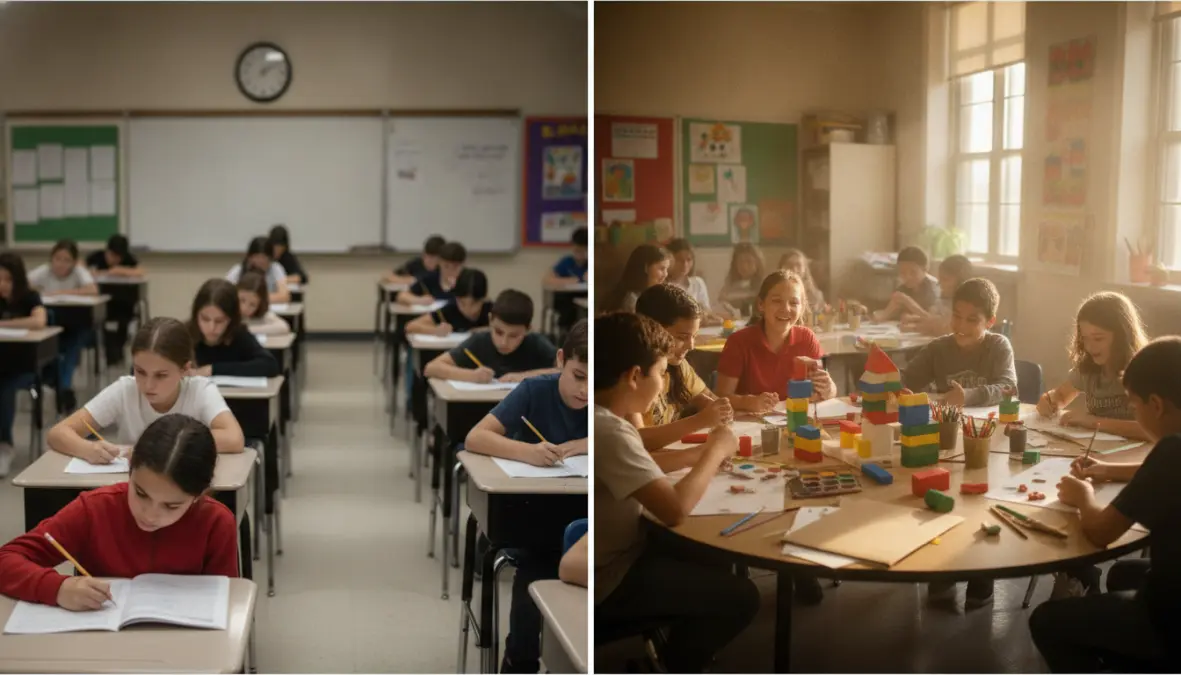
Among the causes of creativity crisis in education, educational standardization stands out as particularly damaging. The increasing emphasis on standardized testing has fundamentally reshaped classroom priorities. Teachers, pressured to improve test scores, focus on memorization and rote learning rather than encouraging students to explore, question, and experiment. The impact of standardized testing on creativity extends beyond curriculum—it shapes how children learn to think.
Budget cuts have decimated arts programs, reducing opportunities for students to engage in open-ended creative activities. Music, visual arts, and drama—subjects that naturally develop divergent thinking skills—are treated as expendable luxuries rather than essential components of cognitive development. Even within remaining arts programs, the focus often shifts toward technical proficiency rather than creative exploration.
The classroom structure itself prioritizes finding the “right” answer over exploring multiple possibilities. Students learn quickly that creativity is risky—wrong answers are penalized, unconventional approaches are discouraged, and success means conforming to predetermined expectations. This systematic suppression of creative thinking skills begins as early as kindergarten and intensifies throughout formal education.
The Digital Age’s Impact on Cognitive Flexibility
Our digital habits profoundly affect cognitive flexibility and creative capacity. While technology offers unprecedented access to information, the way we typically engage with it promotes passive consumption rather than active creation. Scrolling through curated feeds, watching short-form videos, and consuming algorithmic recommendations doesn’t exercise the same mental muscles as building, making, or imagining.
Social media algorithms create echo chambers that limit exposure to diverse perspectives—the raw material of lateral thinking. When we’re constantly fed content that confirms existing viewpoints, we lose opportunities to encounter the unexpected connections and cognitive dissonance that spark creative insights. The reduction in attention span compounds this problem; creativity often requires sustained focus and the mental space to let ideas develop and connect.
Paradoxically, we’ve lost the creative benefits of boredom. Constant digital stimulation eliminates the downtime where minds wander and make unexpected connections. Research shows that neuroplasticity—the brain’s ability to form new neural pathways—benefits from periods of unfocused attention, precisely what our device-dependent lives eliminate. This pattern extends to workplace practices as well, where algorithmic systems increasingly shape human potential and opportunity.

Reversing the Trend: Strategies to Rebuild Creative Capacities
Fortunately, creative potential isn’t fixed. Learning how to improve divergent thinking skills involves deliberate practice and environmental changes. At the individual level, techniques like brainstorming (with proper facilitation that delays judgment), SCAMPER (Substitute, Combine, Adapt, Modify, Put to other uses, Eliminate, Reverse), and mind mapping can strengthen creative problem solving muscles.
Educational reform must prioritize restoring creativity in modern society by rebalancing curriculum. This means protecting and expanding arts education, incorporating more project-based learning, allowing for multiple solution paths, and using divergent thinking assessment methods alongside standardized tests. Some schools are pioneering “genius hour” programs where students pursue self-directed projects, or implementing design thinking curricula that explicitly teach creative frameworks.
Organizations can foster innovation by creating psychological safety for experimentation, dedicating time for exploratory projects, encouraging cross-disciplinary collaboration, and rewarding novel approaches even when they don’t succeed. Companies like Google’s famous “20% time” policy demonstrate how structured freedom can unleash creative thinking skills.
Daily habits matter too. Engaging in diverse experiences, practicing mindfulness to create mental space, limiting passive screen time, pursuing hands-on hobbies, and deliberately seeking perspectives different from your own all enhance cognitive flexibility. Even simple practices like taking different routes to work or trying unfamiliar cuisines can strengthen the neural pathways that support lateral thinking and ideational fluency—the ability to generate multiple ideas rapidly.
FAQ: Common Questions About the Creativity Crisis
Is creativity really declining or just changing?
The data shows genuine decline in measurable creative abilities, particularly divergent thinking skills. While digital tools create new forms of creative expression, standardized assessments reveal decreased capacity for original thinking and problem-solving flexibility across populations.
At what age does creative thinking peak?
Research suggests creative thinking peaks around age 5-6, before formal schooling’s emphasis on standardization takes full effect. However, with proper cultivation, adults can maintain and even enhance creative capacities throughout life thanks to neuroplasticity.
Can creativity be taught or improved in adults?
Absolutely. While childhood represents a critical period, adult brains remain capable of developing creative thinking skills through deliberate practice, environmental changes, and techniques that challenge habitual thought patterns. Consistency matters more than age.
What countries are doing best at preserving creative thinking?
Education systems emphasizing play-based learning and minimizing standardized testing—such as Finland, Singapore’s recent reforms, and aspects of the Reggio Emilia approach in Italy—show stronger creative outcomes. These systems prioritize exploration over memorization and integrate arts throughout curricula.
The creativity crisis represents one of the most consequential challenges facing modern society, yet it remains largely invisible in public discourse. By understanding its causes and implementing evidence-based solutions at individual, educational, and organizational levels, we can reverse this decline. The future doesn’t just need people who know the right answers—it needs people who can imagine questions we haven’t yet thought to ask. Just as we’re exploring breakthroughs in extending human lifespan, we must invest equally in enhancing the quality of thinking throughout those extended years. The time to reclaim our creative potential is now.