The Productivity Paradox: Why Working Less Can Accomplish More

Ever notice how your best ideas come when you’re not actually working? Maybe in the shower, on a walk, or right before falling asleep? That’s not a coincidence—it’s the productivity paradox in action. We’ve been sold a lie that more hours equal more output, but the reality is far more counterintuitive. The secret to getting more done might actually be working less.
What Is the Productivity Paradox?
The productivity paradox is a phenomenon where increasing work hours beyond a certain threshold actually decreases overall output and quality. It’s the recognition that efficiency vs hours worked don’t have a linear relationship—in fact, they often move in opposite directions.
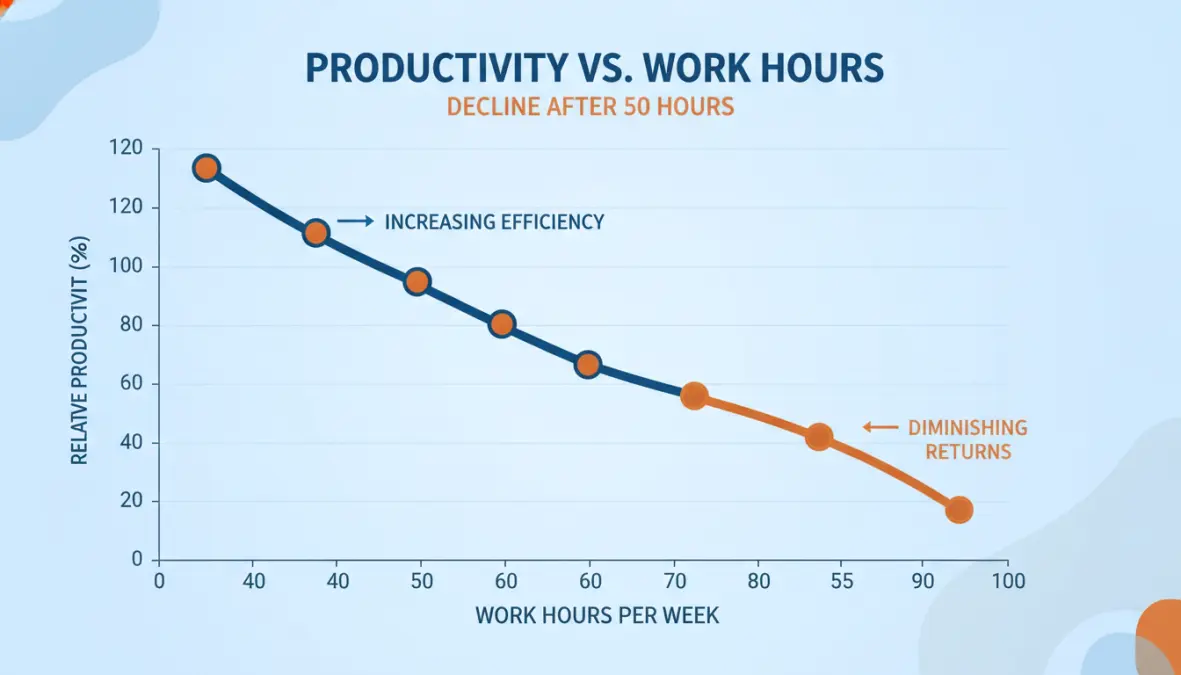
Research from Stanford University found that productivity per hour declines sharply when the workweek exceeds 50 hours, and drops off so dramatically after 55 hours that there’s no point in working more. This is the concept of diminishing returns work in practice: the productivity curve rises initially, hits an optimal point (typically around 40 hours per week), then begins to decline.
Think of it like filling a bucket with a hole in it. At first, water accumulates faster than it leaks out. But as you pour more in (work more hours), the hole gets bigger (fatigue increases), until you’re pouring in water that immediately drains away. You’re busy, exhausted, but the bucket isn’t getting any fuller. Companies in Japan have even coined a term for death by overwork—karoshi—highlighting the extreme end of this spectrum.
The Hidden Costs of Overwork Culture
The overwork culture thrives on productivity myths that sound logical but crumble under scrutiny. “First in, last out” employees are praised. Vacation days go unused. Emails sent at midnight signal dedication. But this badge-of-honor mentality comes with steep hidden costs.
The American Institute of Stress reports that job stress costs U.S. businesses over $300 billion annually in absenteeism, turnover, diminished productivity, and medical expenses. When employees are chronically overworked, error rates spike, creativity plummets, and decision-making suffers. A study in the Harvard Business Review found that managers couldn’t distinguish between employees who actually worked 80 hours and those who just pretended to—because output was essentially the same.
The promise of working less achieving more isn’t just about individual wellbeing (though that matters enormously). It’s about recognizing that work-life balance productivity creates sustainable performance. Burned-out employees don’t innovate, don’t collaborate effectively, and don’t stick around. The real measure of productivity isn’t hours clocked but problems solved, value created, and objectives achieved.
The Biology Behind Diminishing Returns
There’s hard science behind why efficiency vs hours worked diverges. Our brains aren’t designed for sustained cognitive effort without recovery. When we work continuously, we experience cognitive fatigue—the depletion of mental resources like attention, willpower, and working memory.
Neuroscience research shows that the prefrontal cortex, responsible for complex thinking and decision-making, requires significant glucose and oxygen. Extended work periods deplete these resources faster than they’re replenished. What follows is predictable: slower processing speeds, impaired judgment, reduced impulse control, and decreased creativity. This biological reality makes diminishing returns work inevitable, not optional. Rest isn’t laziness—it’s a prerequisite for peak performance, as explored in understanding how our natural rhythms affect productivity.
Real-World Examples of Working Less, Achieving More
Theory is nice, but what about practice? Companies worldwide are testing reduced hours with remarkable results. Microsoft Japan’s four-day workweek experiment saw productivity jump 40%. Perpetual Guardian in New Zealand reported similar gains alongside improved employee wellbeing and work-life balance.
In Iceland, one of the world’s largest trials of reduced work hours (moving from 40 to 35-36 hours weekly) involved 2,500 workers across various sectors. The outcome? Productivity maintained or improved in the majority of workplaces, while worker wellbeing dramatically increased. You can dive deeper into these findings in comprehensive analyses of four-day workweek experiments.
These examples demonstrate why working fewer hours increases productivity: with less time available, people focus on what truly matters. They eliminate low-value tasks, minimize distractions, and engage in deep work rather than performative busyness.

Building a Sustainable Productivity System
Understanding the paradox is step one. Implementing sustainable productivity requires deliberate system design. Here’s how to accomplish more by working less:
Prioritize ruthlessly. Not everything deserves equal attention. Use frameworks like the Eisenhower Matrix or the 80/20 rule to identify high-impact activities. Most people waste hours on tasks that contribute minimally to actual goals.
Manage energy, not just time. Time management alone misses the point. A tired brain at 10 PM isn’t as productive as an alert one at 10 AM, even with identical minutes available. Align demanding cognitive tasks with your peak energy periods. Consider tools like circadian-aligned lighting to optimize your environment.
Build in recovery. Strategic breaks aren’t productivity killers—they’re productivity enablers. The research on rest and recovery is clear: techniques like the Pomodoro method, walking meetings, or even brief nature exposure significantly boost subsequent focus and creativity. Activities like cold water therapy can also aid recovery and mental clarity.
Measure outcomes, not inputs. Shift from “hours worked” to “objectives achieved.” This encourages work efficiency and eliminates the incentive to appear busy without being productive. Organizations embracing this mindset see dramatic improvements in both morale and results.
Leverage technology wisely. AI productivity tools can automate routine tasks, freeing mental bandwidth for work that requires genuine human creativity and judgment. Similarly, analog productivity methods help some people disconnect from digital overwhelm and focus more intentionally.
FAQ: Common Questions About the Productivity Paradox
Does working less really increase productivity?
Yes, scientific evidence consistently shows that does working longer hours decrease productivity beyond certain thresholds (typically 40-50 hours weekly). The benefits of reducing work hours include improved focus, creativity, decision-making quality, and significantly reduced burnout prevention needs.
What is the optimal number of work hours per week?
Research suggests optimal work hours fall between 35-40 hours weekly for most knowledge workers. Individual variation exists based on work type, personal energy patterns, and other factors, but exceeding 50 hours consistently produces diminishing returns for nearly everyone.
How can I convince my employer about working less?
Focus on outcomes, not hours. Propose a trial period where you track specific productivity metrics while working reduced hours. Present evidence from the productivity paradox in modern workplace research, including case studies showing maintained or improved output with fewer hours. Frame it as work efficiency optimization, not laziness.
What are productivity myths I should stop believing?
Common productivity myths include: more hours always equal more output; being busy means being productive; multitasking is efficient; skipping breaks saves time; and willpower alone can overcome fatigue. All are contradicted by cognitive science and workplace research.
How does work-life balance affect productivity?
Work-life balance productivity operates through multiple channels: reduced burnout, improved mental health, enhanced creativity from diverse experiences, better physical health reducing sick days, and increased engagement and loyalty. Balance isn’t the enemy of productivity—it’s the foundation.
The productivity paradox challenges everything modern work culture taught us. But the evidence is overwhelming: scientific proof working less is better exists across disciplines, industries, and countries. Breaking free from the overwork cycle isn’t about doing less—it’s about doing what matters, with full energy and focus. As counterintuitive as it sounds, the path to accomplishing more often starts with working less. The question isn’t whether you can afford to try this approach—it’s whether you can afford not to.