Perovskite Solar Cells: The Revolutionary Technology Transforming Solar Energy
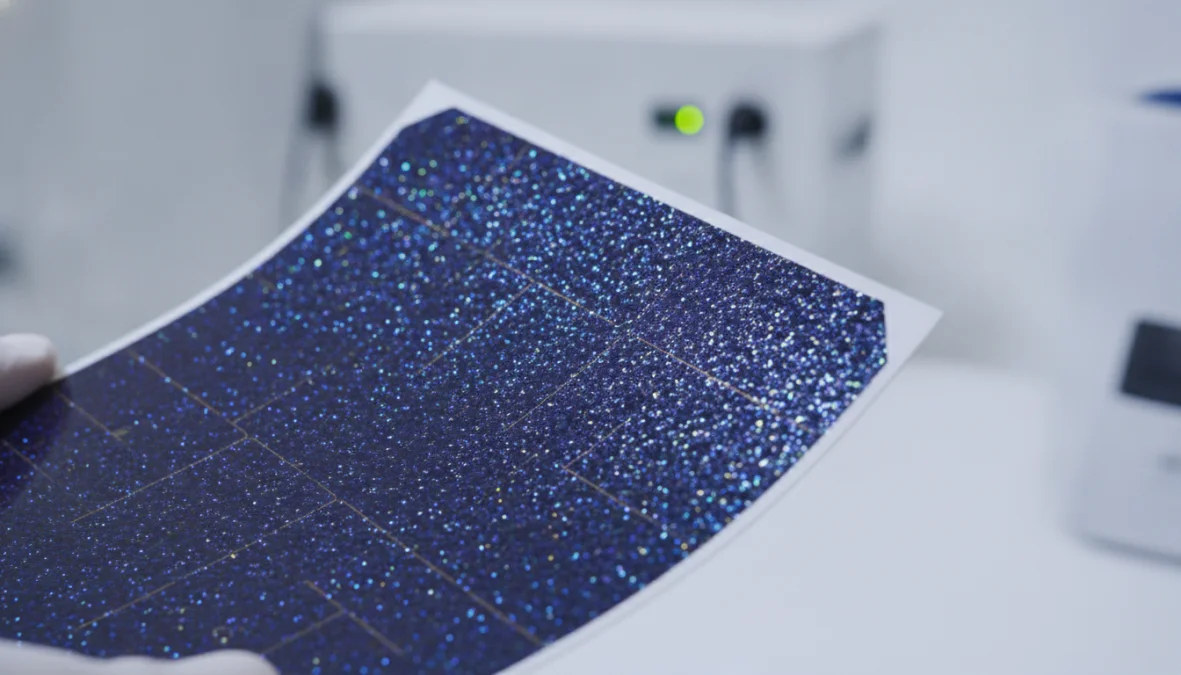
Imagine solar panels that are lighter than a feather, flexible enough to wrap around curved surfaces, and cheaper to produce than traditional silicon cells. That’s not science fiction—it’s the promise of perovskite solar cells, a breakthrough technology that’s rapidly reshaping the renewable energy landscape. While silicon has dominated photovoltaics for decades, these next-generation solar cells are proving they can match—and potentially surpass—conventional technology in efficiency, all while offering unprecedented versatility. Let’s dive into what makes perovskite solar technology so revolutionary and why it’s generating massive excitement in the clean energy sector.
What Are Perovskite Solar Cells and Why They Matter
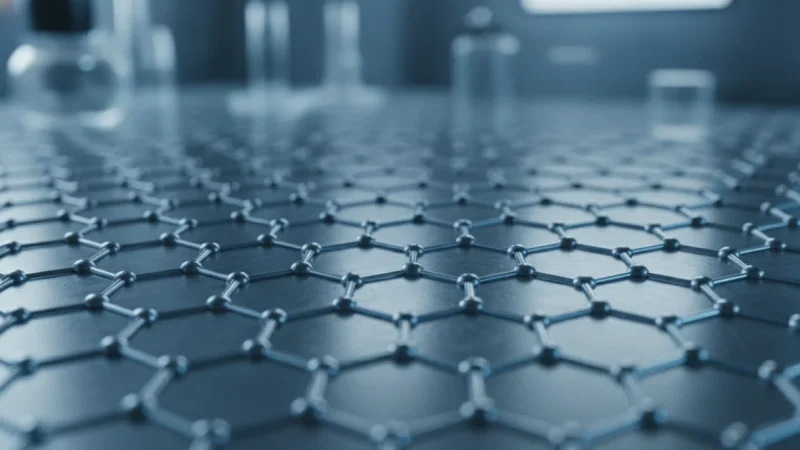
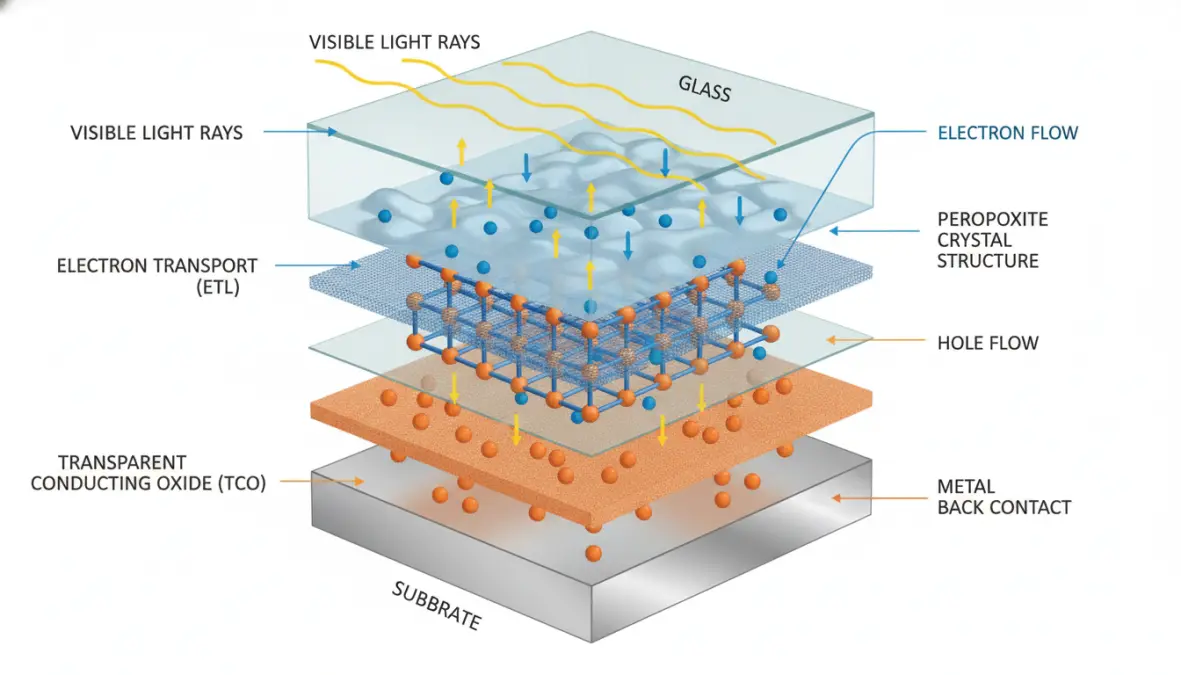
At their core, perovskite solar cells are named after their unique crystal structure—the same arrangement found in the mineral calcium titanium oxide (CaTiO₃). In photovoltaics, we’re typically talking about hybrid perovskite materials, which combine organic and inorganic components in a structure with the formula ABX₃. The most common variant uses methylammonium lead halide, where light absorption triggers electron excitation that generates electrical current.
So how do perovskite solar cells work? When photons hit the perovskite layer, they excite electrons from the valence band to the conduction band, creating electron-hole pairs. These charge carriers then migrate to different electrodes through electron and hole transport layers, generating usable electricity. The brilliance lies in the material’s exceptional charge carrier mobility and its ability to absorb light across a broad spectrum—all while being just a few hundred nanometers thick.
Unlike traditional silicon panels that require high-temperature processing and rigid substrates, perovskite solar technology can be manufactured through solution processing—essentially printed or coated onto flexible substrate materials at relatively low temperatures. This makes them true third generation solar cells, joining the ranks of advanced thin film photovoltaics that promise to democratize solar energy through reduced production costs and unprecedented application flexibility. We’re talking about solar cells that could be integrated into windows, clothing, or even curved automotive surfaces—applications where rigid silicon simply can’t compete.
Performance and Efficiency: How Perovskite Technology Stacks Up
The perovskite efficiency story is nothing short of remarkable. When researchers first developed working perovskite solar cells, they achieved a modest 3.8% power conversion efficiency. Fast forward just over a decade, and laboratory prototypes now exceed 25% efficiency for single-junction cells—approaching the theoretical Shockley-Queisser limit for single-bandgap solar cells and rivaling the best monocrystalline silicon panels on the market.
When comparing perovskite solar cell efficiency vs silicon, the current commercial silicon panels typically deliver 20-22% efficiency, while high-end monocrystalline versions reach 24-26%. What’s impressive isn’t just that perovskites have caught up in record time, but how they achieve this performance. Their superior absorption coefficient means they capture more light using far less material—a perovskite layer might be 500 nanometers thick versus silicon’s 180 micrometers. Additionally, bandgap engineering allows researchers to tune the absorption spectrum by adjusting the chemical composition, optimizing performance for specific lighting conditions or applications.
Perhaps the most exciting development in perovskite solar technology is its performance in low-light conditions. Where silicon efficiency drops significantly under diffuse or indoor lighting, perovskites maintain better performance, opening possibilities for indoor energy harvesting. Their flexibility also means they can be deployed in orientations and locations where traditional panels would be impractical, potentially increasing real-world energy capture beyond what raw efficiency numbers suggest.
Tandem Cell Architecture: The Path to Maximum Efficiency
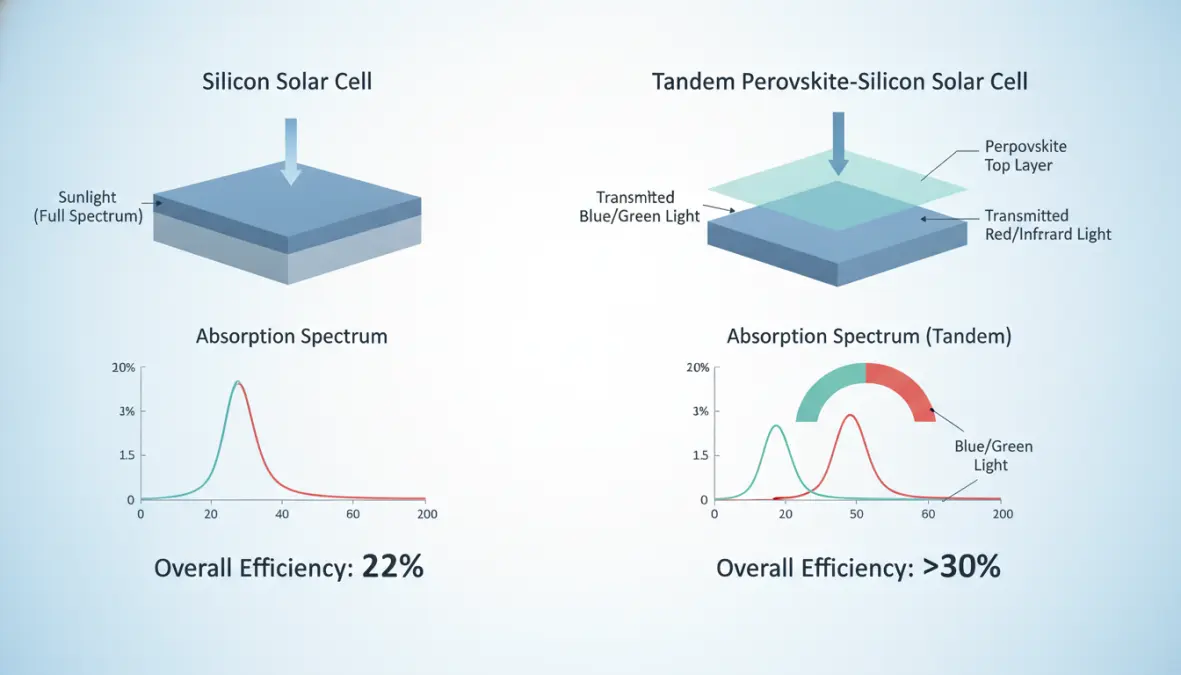
The true game-changer for next generation solar cells is tandem technology. By stacking a perovskite cell (optimized for high-energy blue and green light) atop a silicon cell (which captures lower-energy red and infrared light), researchers have created tandem solar cells that shatter single-material efficiency limits. These perovskite-silicon tandems have already achieved laboratory efficiencies exceeding 33%, with theoretical maximums approaching 43%.
The magic lies in complementary absorption spectra—each layer captures different wavelengths, ensuring minimal energy loss. Recent commercial prototypes have demonstrated over 30% efficiency in real-world conditions, suggesting that tandem architectures could become the dominant technology within the next decade, much like how digital twin technology is revolutionizing manufacturing through optimized layered processes.
Challenges and Future Outlook for Perovskite Photovoltaics
Despite their tremendous potential, perovskite solar cells face significant hurdles before mass commercialization. The most critical issue is stability—specifically perovskite solar cell stability issues related to long-term degradation. Traditional silicon panels carry 25-30 year warranties, but perovskites historically degrade rapidly when exposed to moisture, oxygen, heat, and UV radiation. Moisture degradation remains particularly problematic, as water molecules can penetrate the crystal structure, breaking down the light-absorbing layer within weeks or months without proper protection.
Another serious concern is lead toxicity concerns. Most high-efficiency perovskites contain lead, raising questions about environmental impact if panels break or reach end-of-life. Researchers are actively developing lead-free alternatives using tin or bismuth, though these currently sacrifice some efficiency. Meanwhile, advanced encapsulation technologies show promise—recent breakthroughs have demonstrated perovskite modules maintaining over 95% initial efficiency after 1,000 hours of accelerated aging tests, equivalent to several years of outdoor operation.
So what’s the realistic timeline for commercial perovskite solar panels availability? Several companies are already producing small-scale modules for niche applications—portable chargers, building-integrated photovoltaics (BIPV), and indoor energy harvesting. The cost of perovskite solar cell manufacturing remains attractively low, with estimates suggesting production costs could be 50-70% below silicon once scaled. Industry experts predict limited commercial availability for specialized applications within 2-3 years, with broader market penetration possible within 5-10 years, contingent on solving stability challenges. Applications like flexible BIPV, where aesthetics and weight matter more than 30-year warranties, will likely see adoption first—similar to how ambient computing is first transforming spaces where integration matters most.
The advantages and disadvantages of perovskite solar cells create a complex picture. Their lightweight nature, flexibility, low production costs, excellent low-light performance, and tandem potential represent transformative advantages. However, current stability limitations, lead content, and lack of long-term field data remain significant disadvantages that must be addressed. The future of perovskite photovoltaics likely lies not in replacing silicon entirely, but in complementing it—through tandem architectures and specialized applications where their unique properties shine.
FAQ
Are perovskite solar cells commercially available?
Limited commercial availability exists primarily for niche applications like portable devices and building-integrated photovoltaics. Several companies offer small-scale modules, but widespread residential/utility-scale deployment remains in development. Full commercialization depends on improving long-term stability and scaling manufacturing processes, likely within the next 5-10 years.
How long do perovskite solar cells last?
Current perovskite solar cells typically last 1-5 years depending on encapsulation quality and environmental conditions, far short of silicon’s 25-30 year lifespan. However, recent stability improvements show modules maintaining 95%+ efficiency after accelerated aging equivalent to several years, suggesting commercial products may soon achieve 10-15 year operational lifetimes.
Are perovskite solar cells better than silicon?
Perovskites excel in specific areas—lighter weight, flexibility, low-light performance, and lower manufacturing costs. They match silicon’s efficiency and exceed it in tandem configurations. However, silicon currently wins on proven longevity and large-scale deployment. The technologies will likely coexist, each suited to different applications rather than one replacing the other entirely.
What is the cost of perovskite solar panels?
While commercial pricing isn’t fully established, estimates suggest perovskite manufacturing costs could be 50-70% lower than silicon due to solution-based processing and reduced material usage. Early commercial modules for specialized applications cost more due to limited production scale, but mass-produced panels could potentially retail significantly below current silicon prices once stability challenges are resolved.
The revolution in solar energy isn’t just about incremental improvements—it’s about fundamentally reimagining what solar panels can be and where they can go. As perovskite technology matures, we’re not just looking at cheaper electricity; we’re envisioning a world where every surface becomes a potential power source, bringing clean energy to places and applications we never thought possible.