Ambient Computing: The Invisible Technology Shaping Your Environment

You wake up, and your bedroom gradually fills with soft light that mimics the sunrise. Your coffee maker starts brewing before you even step into the kitchen. As you leave home, the thermostat automatically adjusts, and your security system arms itself. This isn’t science fiction—it’s ambient computing, the invisible technology that’s quietly transforming how we interact with our environments.
What Is Ambient Computing and Why It Matters
Ambient computing represents a fundamental shift in how we interact with technology. Unlike traditional computing, where you actively engage with screens and interfaces, ambient computing works in the background, anticipating your needs without requiring explicit commands. It’s the evolution of ubiquitous computing and ambient intelligence, creating environments where technology becomes virtually invisible technology.
So how does ambient computing work in daily life? The magic happens through a sophisticated network of sensors, artificial intelligence, and machine learning algorithms that constantly observe, learn, and adapt. Voice assistants like Alexa or Google Assistant are probably the most recognizable examples—they listen for your commands and respond without you touching a screen. Smart thermostats learn your temperature preferences and schedule, adjusting automatically. Motion-activated lights illuminate your path without flipping a switch.
The key difference between ambient computing vs traditional computing lies in the user experience. Traditional computing requires deliberate interaction: you open your laptop, launch an application, input commands. Ambient computing eliminates these friction points. The technology fades into the background, responding to context clues like your location, time of day, behavioral patterns, and even biometric data. This creates a seamless experience where technology serves you without demanding your constant attention.
How Ambient Computing Works: The Technology Behind Smart Environments
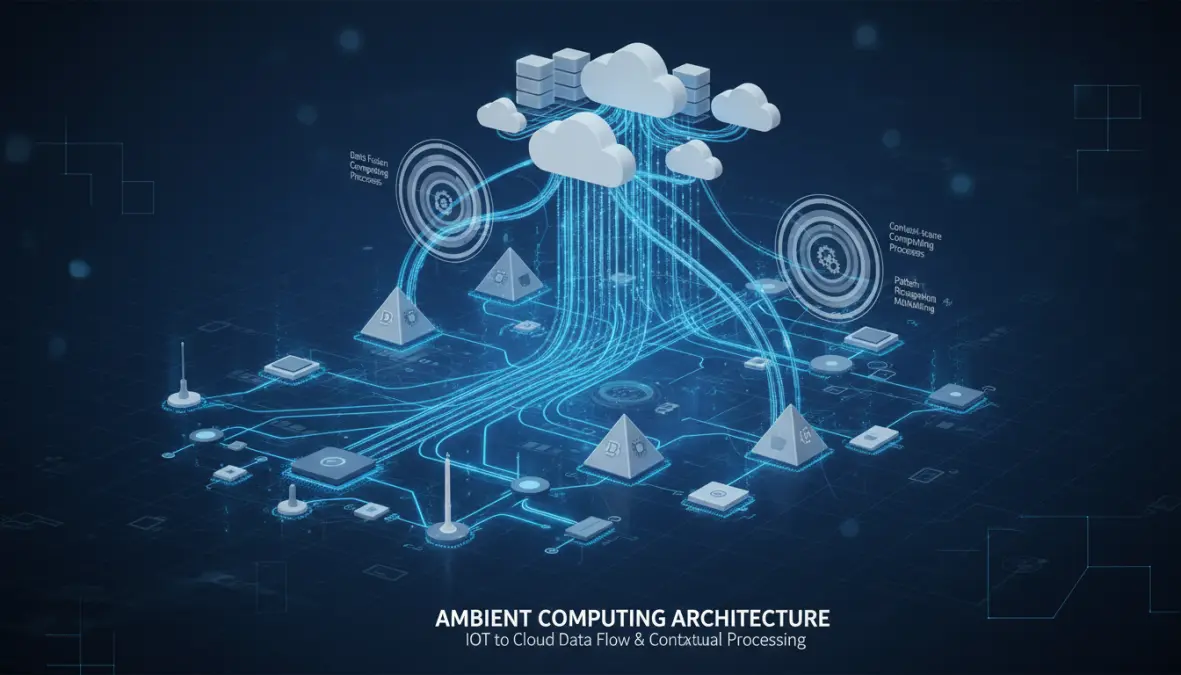
Understanding the architecture behind smart environments helps demystify this seemingly magical technology. At its core, ambient computing relies on an intricate IoT ecosystem—a web of connected devices that communicate with each other and central processing systems.
The foundation consists of sensor networks embedded throughout your environment. These sensors collect data points: temperature, humidity, motion, light levels, sound, air quality, and more. This constant stream of information flows to processing systems that employ machine learning algorithms to identify patterns and make predictions. The real innovation lies in context-aware computing—the ability to interpret not just individual data points, but understand the broader situation.
Edge computing plays a crucial role in making ambient systems responsive. Rather than sending all data to distant cloud servers, edge computing processes information locally on devices or nearby hubs. This reduces latency dramatically—your smart doorbell can recognize a familiar face and unlock the door in milliseconds rather than seconds. The combination of cloud infrastructure for heavy computational tasks and edge processing for real-time responses creates the responsiveness that makes pervasive computing feel natural.
Communication protocols like Zigbee, Z-Wave, Thread, and Matter enable different devices from various manufacturers to work together. This interoperability is essential for creating truly integrated automation systems that feel cohesive rather than like a collection of disconnected gadgets.
Real-World Applications of Ambient Computing
The benefits of ambient computing technology become clear when examining practical applications across different sectors. In smart homes, ambient computing examples in smart homes include Philips Hue lights that adjust color temperature throughout the day to support your circadian rhythm, Nest thermostats that learn when you’re typically home, and Samsung SmartThings systems that orchestrate multiple devices to create scenarios like “movie mode” or “goodnight routine.”
The automotive industry showcases advanced implementations through self-driving vehicles that constantly process sensor data from cameras, LiDAR, and radar to navigate safely. Tesla’s Autopilot and similar systems represent ambient computing on wheels—the car becomes an intelligent environment that assists or takes over driving tasks based on context.
In healthcare, ambient computing monitors patients continuously without intrusive procedures. Wearable sensors track vital signs, detect falls, and alert caregivers to anomalies. Hospital rooms equipped with ambient systems can automatically adjust lighting for procedures, monitor hand-washing compliance, and track equipment locations. If you’re interested in the broader implications of AI in medical settings, check out the ethics of AI in healthcare.
Retail environments use ambient computing to personalize shopping experiences. Stores track customer movement patterns, adjust digital signage based on who’s nearby, and offer location-based promotions. Workplace applications include intelligent conference rooms that automatically configure displays, adjust lighting and temperature, and even transcribe meetings using voice recognition.

Privacy and Security Challenges
The always-on nature of ambient computing raises legitimate ambient computing privacy concerns. When sensors constantly monitor your environment, collecting data about your routines, preferences, and behaviors, you’re essentially trading privacy for convenience. Every voice assistant query, motion sensor trigger, and smart camera recording creates a detailed digital footprint of your life.
Security vulnerabilities multiply with every connected device. Hackers can potentially access your sensor networks, turning your smart home into a surveillance tool or entry point for broader attacks. The interconnected nature of ambient systems means one compromised device can jeopardize your entire network.
Best practices for protecting yourself include using strong, unique passwords for each device, regularly updating firmware, segmenting your network to isolate IoT devices, and carefully reviewing privacy policies before adopting new ambient technologies. Transparency is crucial—users deserve to know what data is collected, how it’s used, and who can access it.
Regulations like GDPR in Europe establish frameworks for data protection, requiring explicit consent and giving users the right to access or delete their data. As ambient computing becomes more pervasive, we’ll likely see additional legislation balancing innovation with privacy protection.
The Future of Ambient Computing: What to Expect
The future of ambient computing and AI promises even more seamless integration of technology into our environments. The rollout of 5G and eventual 6G networks will dramatically increase the number of devices that can connect simultaneously while reducing latency to near-instantaneous levels. This connectivity boost enables truly responsive ambient intelligence that reacts in real-time to changing conditions.
Advanced AI at the edge will make devices smarter without relying on cloud connectivity. Your smart home could continue functioning intelligently even during internet outages. Human computer interaction will evolve beyond voice and touch to include gesture recognition, gaze tracking, and potentially even brain-computer interfaces that respond to your thoughts.
Hyper-personalization will reach new levels as systems learn from years of behavioral data, predicting your needs with uncanny accuracy. Your environment could automatically adjust based on detecting stress levels through biometric sensors, perhaps dimming lights and playing calming music when needed—a concept explored in biohacking approaches.
Smart cities will deploy ambient computing at scale, optimizing traffic flow, energy distribution, and public services. Implementing ambient computing in business will become standard practice, with offices that automatically configure themselves for each employee’s preferences and work style.
The path to mainstream adoption faces challenges: establishing universal standards for device communication, addressing privacy concerns through regulation and transparent practices, making technology affordable and accessible, and ensuring these systems enhance rather than replace human agency.
Ambient computing represents a fundamental reimagining of our relationship with technology. As these systems become more sophisticated, the line between physical and digital environments will continue to blur. The question isn’t whether ambient computing will reshape our world—it already is—but how we’ll navigate the balance between convenience and control, efficiency and privacy, automation and autonomy. Are you ready to embrace this invisible revolution?