Chronotype Productivity: How to Schedule Your Day Around Your Natural Rhythm

Ever wonder why you crush your to-do list at 7 AM while your coworker doesn’t hit their stride until noon? Or why forcing yourself into a 9-to-5 schedule feels like swimming upstream? The answer lies in your chronotype—your body’s natural preference for when to sleep, wake, and perform at your best. Understanding chronotype productivity isn’t just interesting science; it’s the key to unlocking your peak performance without fighting your biology every single day.
Understanding Your Chronotype and Its Impact on Productivity
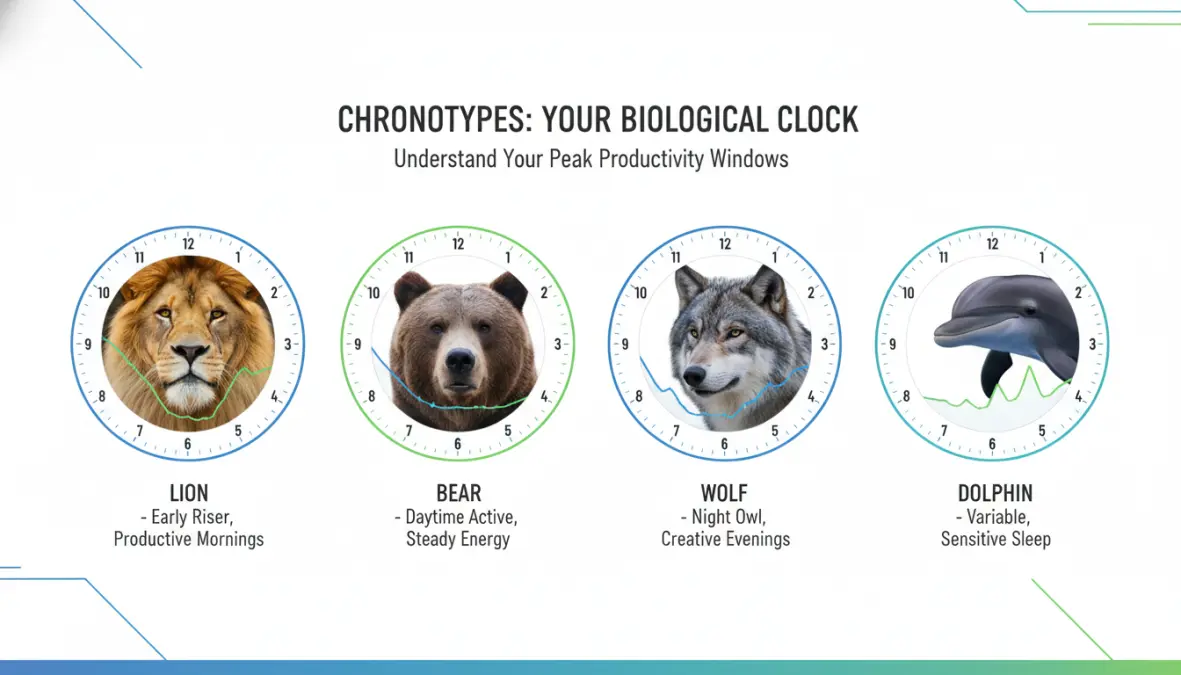
Your chronotype productivity is determined by your biological clock productivity, which is largely written in your DNA. Scientists have identified several chronotype categories, with the most popular frameworks being the four-animal model (Lion, Bear, Wolf, Dolphin) or the simpler morning lark versus evening owl classification.
Here’s the breakdown: Lions (morning larks) wake naturally before dawn and peak early. Bears, comprising about 50% of the population, follow the sun’s schedule closely. Wolves (night owls) struggle with early mornings but thrive in the evening. Dolphins are light sleepers with irregular patterns, often dealing with insomnia.
While your circadian rhythm is the 24-hour biological cycle that regulates your sleep wake cycle, your chronotype is your individual expression of that rhythm. Think of circadian rhythm as the general human operating system, and chronotype as your personalized settings.
Quick self-assessment: When do you naturally wake without an alarm on vacation? When do you feel most mentally sharp? If you answered “sunrise” and “morning,” you’re likely a Lion. If you said “mid-morning” and “late afternoon/evening,” welcome to Wolf territory. Research shows chronotypes are about 50% genetic, influenced by variations in clock genes like PER3 and CLOCK.
Understanding sleep chronotype optimization matters because forcing yourself into the wrong schedule doesn’t just feel bad—it measurably tanks your performance, creativity, and even health. As explored in The Science of Sleep: Why Your Chronotype Matters More Than You Think, misalignment between your chronotype and schedule creates “social jet lag,” associated with increased obesity, depression, and cardiovascular risks.
How to Design Your Ideal Chronotype Work Schedule
Now for the good stuff: how to schedule work around your chronotype. The secret to chronotype scheduling is aligning your most demanding tasks with your biological prime time—those golden hours when your brain fires on all cylinders.
Your energy levels throughout day aren’t random. They’re orchestrated by hormones like cortisol (which peaks shortly after waking in the cortisol awakening response) and melatonin (which rises in the evening). Additionally, ultradian rhythms—90-minute cycles of alertness—affect your focus throughout the day.
Morning Chronotypes: Early Bird Optimization Strategies
If you’re wondering when should early birds do creative work, the answer is simple: immediately after your cortisol peak, typically between 6-10 AM. This is your peak performance timing window.
Here’s an optimal chronotype work schedule for morning larks:
- 5:30-6:30 AM: Wake naturally, light exercise, breakfast
- 7:00-10:00 AM: Deep work block—tackle your most cognitively demanding tasks, creative projects, strategic thinking
- 10:00-11:30 AM: Collaborative work, meetings, emails
- 12:00-1:00 PM: Lunch and brief recharge
- 1:00-3:00 PM: Expect the afternoon slump—schedule administrative tasks, light meetings, routine work
- 3:00-5:00 PM: Second (smaller) focus window for finishing tasks
- 8:00-9:00 PM: Begin wind-down routine as melatonin production timing kicks in
Pro tip for Lions: Don’t schedule important decisions or creative work post-lunch. Your energy naturally dips due to postprandial somnolence and your chronotype’s natural decline. Instead, use this time for tasks requiring less brainpower.
Evening Chronotypes: Night Owl Productivity Framework
For Wolves asking about the best time to work for night owls, your biological prime time typically hits between 4 PM and midnight. The challenge? Most workplaces aren’t designed for you.
Here’s a realistic natural rhythm productivity schedule for evening chronotypes:
- 8:00-9:30 AM: Slow start—light tasks, catching up on communications, coffee
- 9:30-12:00 PM: Gradually warming up—meetings (if unavoidable), collaborative work
- 12:00-2:00 PM: Lunch, movement, creative recharge
- 2:00-4:00 PM: Moderate focus work, project development
- 4:00-8:00 PM: PEAK HOURS—deep work, creative projects, complex problem-solving
- 8:00 PM-12:00 AM: Continued high productivity or wind-down depending on workload
When it comes to morning person vs night owl productivity, research shows neither is inherently better—they’re just different. Wolves often show superior performance on creativity and intelligence tests later in the day, while morning larks excel in the AM.
Survival strategies for Wolves in a 9-to-5 world: negotiate later start times if possible, front-load your mornings with low-stakes tasks, and absolutely protect your evening peak hours from mindless activities. If you must attend early meetings, expose yourself to bright light immediately upon waking to trigger your cortisol response earlier.

Practical Tips for Implementing Chronotype-Based Scheduling
Understanding chronotype based time management strategies is one thing; actually implementing them is another. Here’s how to optimize daily schedule based on chronotype in the real world.
Communication is crucial. Have a conversation with your manager about your natural productivity patterns. Frame it around outcomes: “I’ve noticed my best work happens between X and Y hours. Would it be possible to schedule my deep work then and meetings during my lower-energy periods?” Many forward-thinking companies are embracing chronotype-friendly policies—Microsoft Japan experimented with shorter work weeks, and some tech startups allow complete schedule flexibility.
Track your energy. Apps like Rise Science or even simple spreadsheets can help you identify patterns. Log your energy levels every 2 hours for two weeks to find your true biological prime time. You might be surprised by what you discover about how to find your natural productivity rhythm.
Manage social jet lag. The difference between your weekday and weekend sleep schedules causes mini jet lag every Monday. Try to keep wake times within an hour of consistency, even on weekends.
Can you change your chronotype? Slightly, but not fundamentally. You can shift your schedule by an hour or so through consistent light exposure, meal timing, and exercise, but a Wolf won’t become a Lion. Think adaptation, not transformation.
For those curious about other optimization strategies, check out Biohacking for Beginners: Science-Backed Ways to Optimize Your Health for complementary techniques.
When flexibility isn’t an option: Focus on what you can control. Optimize your sleep quality, use strategic caffeine timing (120-180 minutes after waking for most people), take smart breaks during low-energy periods, and fiercely protect your best hours on weekends for personal projects.
FAQ
Can you change your chronotype?
Not substantially. Your chronotype is about 50% genetic. While you can shift your schedule slightly through light exposure, consistent sleep schedules, and timed meals, a true night owl won’t permanently transform into a morning person. Focus on working with your biology, not against it.
What is the most common chronotype?
Bears are the most common, representing roughly 50% of the population. They naturally follow the solar cycle, feeling awake during daylight and tired when it gets dark. Lions make up about 15-20%, Wolves about 15-20%, and Dolphins about 10%.
How do I convince my employer to let me work according to my chronotype?
Focus on productivity and results. Propose a trial period where you adjust your schedule and track your output. Present research on chronotype productivity gains. Start small—maybe just protecting certain hours for deep work—before requesting major schedule changes.
Do chronotypes affect more than just work productivity?
Absolutely. Your chronotype influences meal timing, exercise performance, medication effectiveness, decision-making quality, and even relationship satisfaction. Misalignment with your chronotype has been linked to obesity, depression, and cardiovascular issues.
Is chronotype the same as circadian rhythm?
No. Your circadian rhythm is the universal 24-hour biological cycle all humans share. Your chronotype is your individual variation within that cycle—essentially where your personal rhythm falls on the early-to-late spectrum.
Working with your chronotype instead of fighting it isn’t laziness—it’s strategic self-awareness. By aligning your schedule with your natural rhythm, you’re not just making life easier; you’re unlocking your genuine peak performance. Start by identifying your chronotype, track your energy patterns, and gradually restructure your day around your biology. Your most productive self is already there, just waiting for the right schedule to shine.