LiFi Technology: How Internet Through Light Bulbs Could Replace WiFi

Imagine getting internet access through the same light bulb illuminating your room. Sounds like science fiction? Well, lifi technology is making this a reality, and it could fundamentally change how we think about connectivity. While we’ve all gotten comfortable with WiFi routers tucked away in corners of our homes, a new wave of visible light communication is emerging that uses LED bulbs to transmit data at speeds that would make your current connection look like dial-up. Let’s dive into how this revolutionary technology works and whether it’s really poised to replace the WiFi we know and love.
What Is LiFi Technology and How Does It Work?
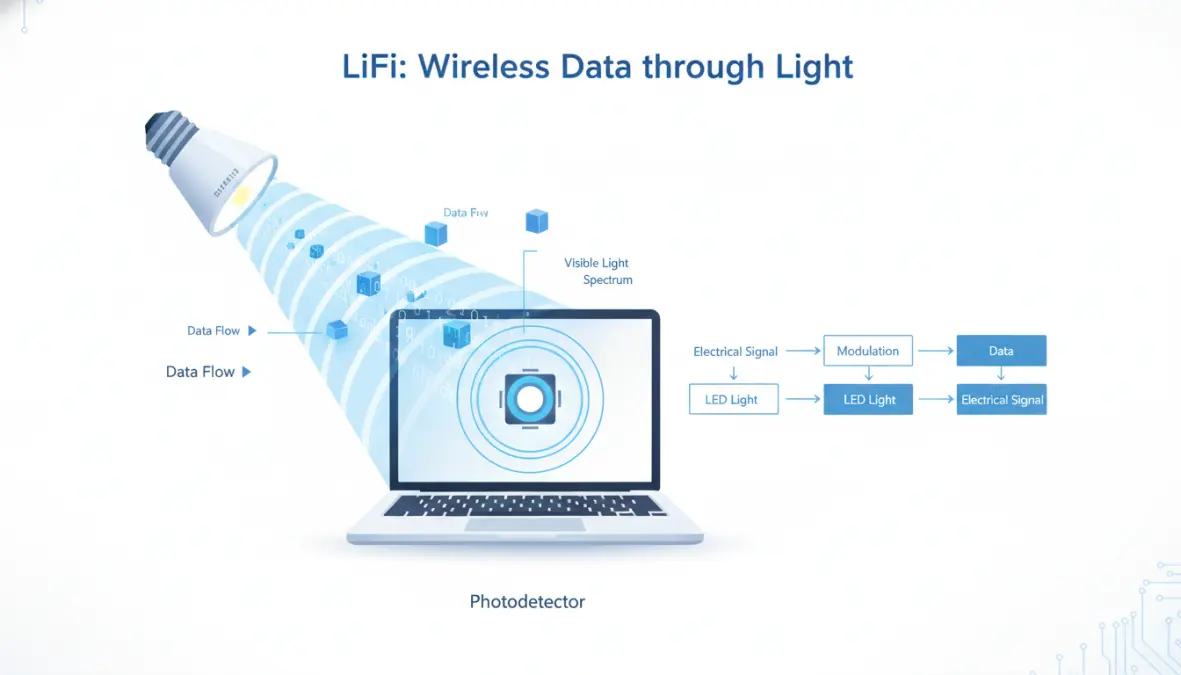
At its core, lifi technology stands for Light Fidelity, and it’s exactly what it sounds like: using light to transmit data instead of radio waves. While WiFi relies on electromagnetic spectrum radio frequencies, how lifi works is through the visible light spectrum emitted by LED bulbs. The concept is brilliantly simple yet technically sophisticated.
Here’s the technical breakdown: LED lights can be switched on and off at incredibly high speeds—so fast that the human eye can’t detect the flickering. By modulating the light intensity through rapid pulses (a process called bandwidth modulation), data is encoded and transmitted through the air. A photodetector on your device picks up these light variations and converts them back into digital information, creating a wireless optical networking connection.
To understand how does lifi technology work with light bulbs in practice, imagine this: when you’re streaming a video, your LED bulb flickers millions of times per second, encoding the video data in binary code (ones and zeros represented by light on and off states). Your laptop or phone equipped with a special LiFi receiver catches these signals, interprets the data, and voilà—you’re watching cat videos through your ceiling light. The same bulb that lights your room becomes a high-speed internet router, making LED data transmission both practical and energy-efficient.
The technology requires three main components: LED light sources (which can be regular smart bulbs with LiFi capability), a modulation driver that controls the flickering, and photodetectors in receiving devices. It’s worth noting that this concept ties into broader trends like ambient computing, where technology seamlessly integrates into our physical environment.
LiFi vs WiFi: Key Differences, Speed, and Performance
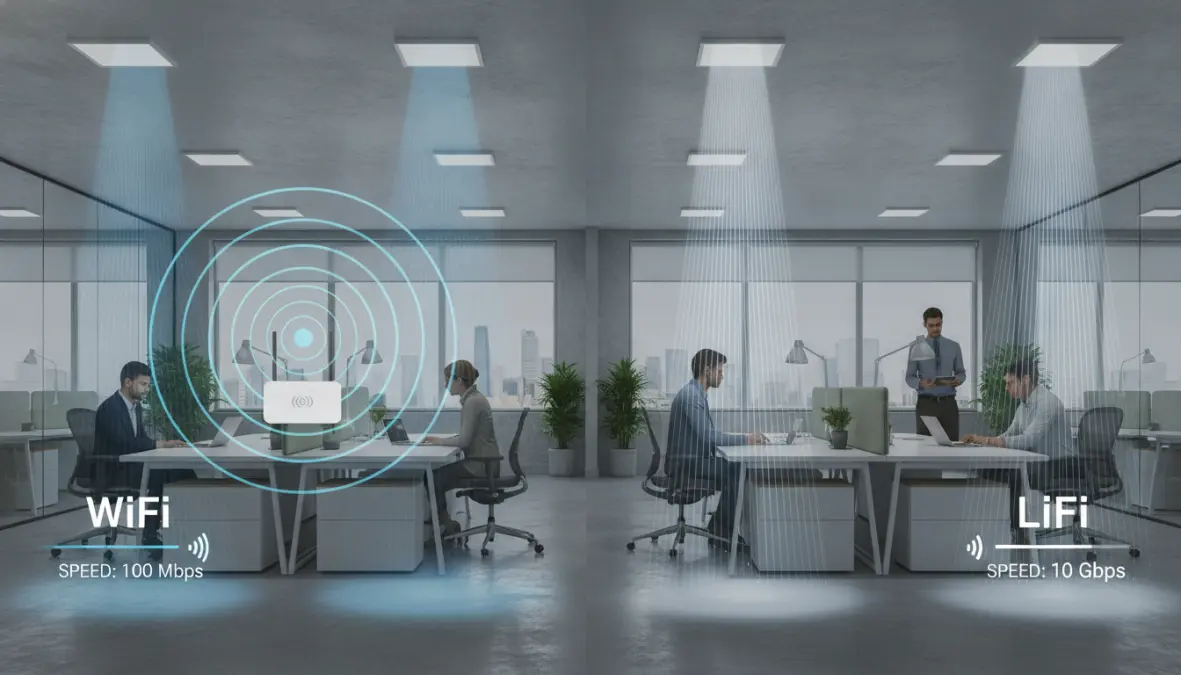
The lifi vs wifi debate isn’t about which technology is universally better—it’s about understanding their distinct advantages and limitations. When comparing lifi internet connection capabilities against traditional WiFi, the differences are striking:
- Speed: LiFi has demonstrated speeds up to 224 Gbps in laboratory conditions, while commercial WiFi 6 typically maxes out around 9.6 Gbps. The lifi speed comparison shows theoretical performance that’s literally 20+ times faster.
- Security: One of the biggest lifi technology advantages is that light doesn’t penetrate walls. Your data stays contained within the room, making unauthorized access significantly harder—no more neighbors piggybacking on your connection.
- Interference: LiFi operates on the visible light spectrum, completely separate from crowded radio frequencies. This means zero interference with WiFi, Bluetooth, or cellular signals.
- Bandwidth availability: The visible light spectrum is 10,000 times larger than the entire radio frequency spectrum, offering virtually unlimited capacity for optical wireless communication.
- Coverage: Here’s the catch—LiFi requires line of sight connectivity. If something blocks the light path between the bulb and your device, the connection drops.
The question “is lifi faster than wifi technology” has a nuanced answer. In ideal conditions with direct line of sight, LiFi absolutely crushes WiFi in raw speed. However, WiFi’s ability to work through walls and around corners gives it practical advantages for whole-home coverage. When considering lifi technology pros and cons compared to wifi, think of LiFi as a Ferrari—incredibly fast but requiring specific road conditions—while WiFi is more like an SUV, versatile and reliable across different terrains.
Real-World Applications and Use Cases
Photonic networking through LiFi isn’t just theoretical—it’s already being deployed in specialized environments where it solves real problems. Hospitals have emerged as prime candidates because infrared communication and visible light transmission don’t interfere with sensitive medical equipment the way radio frequencies can. Some medical facilities are piloting LiFi systems in operating rooms and intensive care units.
Airlines are also experimenting with LiFi for in-flight connectivity. Since every seat has an overhead light, each could become a personal internet hotspot with faster speeds than current satellite-based systems. Industrial environments with heavy machinery that generates RF interference have found LiFi to be a game-changer for reliable connectivity. High-security government facilities appreciate that LiFi’s inability to penetrate walls creates natural security perimeters. These applications demonstrate how lifi internet through light bulbs explained translates from concept to practical implementation.
Current Limitations and Future Outlook
Despite its promise, several obstacles prevent widespread adoption of lifi technology for home internet connection right now. The biggest hurdle is infrastructure—you need LED bulbs equipped with modulation capabilities and devices with compatible photodetectors. Currently, most smartphones and laptops don’t have built-in LiFi receivers, though USB dongles are available.
Mobility is another challenge. Unlike WiFi that follows you from room to room, LiFi requires maintaining that light connection. Step into a shadow or turn your device away from the light source, and you’re disconnected. Direct sunlight can also overwhelm the photodetector, making outdoor use problematic. For those wondering how to set up lifi internet at home, the current answer involves significant investment in specialized equipment and isn’t as plug-and-play as WiFi.
However, the future looks bright (pun intended). Researchers are developing hybrid systems that automatically switch between LiFi and WiFi based on optimal conditions. Integration with 5G and future 6G networks could create seamless connectivity ecosystems. As LED lighting becomes standard worldwide—driven partly by energy efficiency mandates and trends like circadian lighting systems—the infrastructure foundation for LiFi naturally expands. Market analysts predict commercial LiFi adoption could accelerate significantly in the next five years, particularly in enterprise environments.
FAQ: Common Questions About LiFi Technology
Can LiFi work in darkness?
Yes, but with a caveat. LiFi doesn’t require bright visible light to function—it can operate using infrared light that’s invisible to humans. So technically, a room could appear dark while still maintaining a LiFi connection through IR LEDs. However, standard implementations use visible light, so turning off your lights would disconnect you.
Is LiFi faster than fiber optic?
Not quite. Fiber optic connections can deliver speeds well into the terabits per second range over long distances. LiFi’s 224 Gbps peak is impressive for wireless technology but doesn’t surpass high-end fiber. However, LiFi offers wireless flexibility that fiber can’t match—you’re not tethered to a cable.
Can LiFi replace WiFi completely?
In the near future, probably not. The two technologies are better viewed as complementary rather than competitive. LiFi excels in specific scenarios—high-security areas, congested RF environments, or situations requiring extreme speeds in fixed locations. WiFi’s ability to penetrate barriers and provide broader coverage makes it indispensable for general use. A hybrid approach combining both technologies is the most likely outcome.
What do you need to use LiFi?
You need three things: LiFi-enabled LED light fixtures or bulbs, a compatible receiver (either built into your device or via USB dongle), and line-of-sight access to the light source. Currently, consumer availability is limited, though enterprise solutions exist from companies like pureLiFi and Signify.
Is LiFi available for home use?
Limited home solutions are emerging, but widespread consumer availability isn’t here yet. Some companies offer LiFi kits for early adopters and tech enthusiasts, but they’re relatively expensive and require technical knowledge to set up. As with many emerging technologies, enterprise adoption typically precedes consumer markets by several years.
LiFi technology represents a fascinating evolution in how we think about connectivity—transforming every light bulb into a potential internet portal. While it won’t completely replace WiFi anytime soon, its unique advantages in speed, security, and interference-free operation make it an exciting complement to our wireless ecosystem. As LED lighting becomes ubiquitous and receiver technology becomes more accessible, we might find ourselves in a world where our lighting infrastructure doubles as a invisible high-speed data network, literally illuminating the path to faster, more secure internet access. The technology is real, the benefits are compelling, and the future of lifi technology is definitely worth watching—or should we say, worth basking in its light.