Nuclear Fusion Breakthrough: Why Commercial Fusion Power May Finally Be Within Reach
For decades, nuclear fusion has been the ultimate clean energy promise—a technology that could replicate the sun’s power right here on Earth, providing virtually unlimited energy without the radioactive waste of fission or the carbon emissions of fossil fuels. But it’s also been the punchline of a running joke: fusion power is always “30 years away.” Now, however, a genuine nuclear fusion breakthrough has scientists, engineers, and investors believing that commercial fusion power might finally transition from perpetual promise to practical reality.
What Makes Recent Fusion Energy Breakthroughs Different From Past Attempts
The history of nuclear fusion research is littered with incremental progress and dashed hopes. Since the 1950s, scientists have understood that fusing light atomic nuclei—typically deuterium and tritium—releases enormous energy. The challenge has always been achieving a self-sustaining reaction that produces more energy than it consumes, a milestone known as net energy gain.
What changed? In December 2022, the National Ignition Facility (NIF) at Lawrence Livermore National Laboratory achieved a historic fusion ignition achievement: for the first time ever, a fusion reaction produced more energy than the lasers delivered to trigger it. This wasn’t just another baby step—it was proof of concept that the fundamental physics works. The NIF used 192 powerful lasers to compress a tiny pellet of deuterium and tritium, creating conditions similar to those inside stars. While the experiment used more total energy than it produced (when you factor in laser inefficiencies), it demonstrated that the deuterium tritium reaction could achieve ignition—a barrier that had stood for generations.
This fusion energy breakthrough differs from past attempts because it wasn’t theoretical—it was measurable, repeatable, and represents a fundamental shift from “if” to “how soon.” Combined with parallel advances in plasma confinement, superconducting magnets, and computational modeling, the fusion community now has multiple pathways forward rather than betting everything on a single approach.

Leading Technologies Bringing Commercial Fusion Power Closer to Reality
The path to commercial fusion power isn’t monolithic—several competing technologies are racing toward the same goal, each with distinct advantages and challenges. The two primary approaches are magnetic confinement fusion and inertial confinement fusion, though variations within these categories offer fascinating possibilities.
ITER and Tokamak Reactors: The International Effort
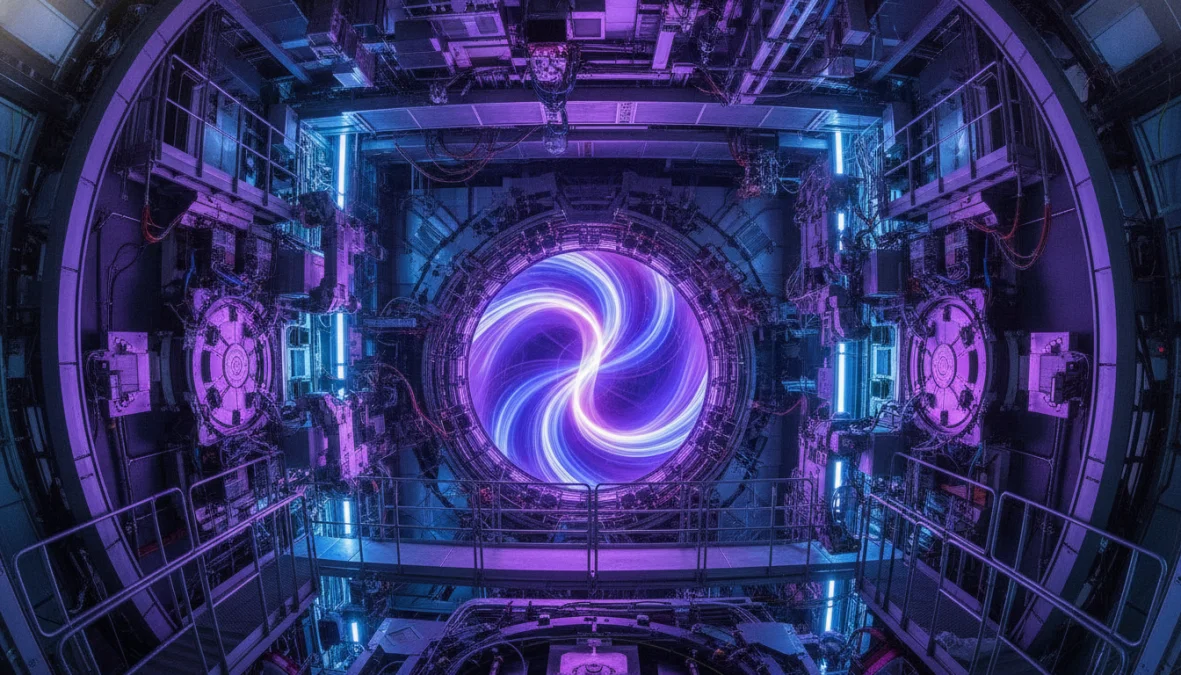
The ITER fusion reactor, currently under construction in southern France, represents the world’s largest international scientific collaboration. This massive tokamak technology project uses powerful magnetic fields to confine superheated plasma in a donut-shaped chamber, keeping it away from physical walls that would otherwise vaporize instantly. ITER aims to achieve a tenfold energy return—producing 500 megawatts from 50 megawatts of input power—demonstrating that a fusion power plant can operate at scales relevant for commercial electricity generation.
The tokamak technology relies on magnetic confinement fusion, using superconducting electromagnets to create the conditions necessary for fusion: temperatures exceeding 150 million degrees Celsius. ITER’s timeline targets first plasma by the late 2020s, with full deuterium-tritium operations following several years later. While critics point to delays and budget overruns, ITER represents an essential stepping stone—proving that fusion can work at power-plant scale. Similar to the nuclear energy comeback we’re witnessing with fission reactors, fusion represents another frontier in carbon-free baseload power.
Private Sector Innovations and Alternative Approaches
While ITER follows the methodical pace of international bureaucracy, private companies are injecting venture capital speed into fusion research. Commonwealth Fusion Systems, spun out of MIT, is building SPARC—a compact tokamak using revolutionary high-temperature superconducting magnets that could achieve net energy gain before ITER does. TAE Technologies pursues an alternative approach using a beam-driven field-reversed configuration, aiming for hydrogen-boron fusion that produces no neutrons.
The National Ignition Facility‘s success has reinvigorated interest in inertial confinement fusion, where powerful lasers or particle beams compress fuel pellets to fusion conditions. Meanwhile, the stellarator design—a twisted cousin of the tokamak—offers potential advantages in plasma stability, with Germany’s Wendelstein 7-X leading this research. This diversity of approaches mirrors how private space exploration has accelerated innovation by pursuing multiple technological pathways simultaneously. The competition among these technologies is healthy: if one approach hits insurmountable obstacles, others continue advancing.
Timeline to Commercial Fusion Power: Challenges and Realistic Expectations
So, when will fusion power be commercially available? The honest answer involves more nuance than a simple date. Optimistic projections from private companies suggest demonstration plants producing electricity to the grid by the early 2030s, with commercial deployment following in the 2040s. The nuclear fusion timeline depends on solving several remaining challenges.
Materials science poses a significant hurdle: reactor walls must withstand years of neutron bombardment that makes steel brittle and degrades performance. Tritium fuel supply presents another challenge—it’s radioactive, rare, and expensive, though fusion reactors can potentially breed their own tritium from lithium blankets surrounding the plasma. The cost of building fusion power plants remains uncertain; early plants will be expensive, but costs should decrease with standardized designs and manufacturing experience—much like solar and wind achieved grid parity through scale.
Answering which countries are leading in fusion research reveals a global effort: the United States, European Union, China, South Korea, and Japan all maintain significant programs. China is aggressively investing in both tokamaks and alternative approaches, while the U.S. combines government labs with an increasingly robust private sector. This international competition and collaboration suggest that clean energy fusion isn’t dependent on any single nation’s success.
The potential impact is transformative: a successful fusion power plant would provide baseload electricity without carbon emissions, minimal radioactive waste, and fuel readily extracted from seawater. Unlike solar and wind, fusion doesn’t depend on weather or time of day. Combined with decentralized energy systems, fusion could anchor a truly sustainable energy future. However, realistic expectations require acknowledging that even successful demonstration plants won’t immediately replace existing infrastructure—integration will take decades.
FAQ: Nuclear Fusion Breakthrough
What is nuclear fusion and how does it differ from nuclear fission?
Fusion combines light atomic nuclei (like hydrogen isotopes) to form heavier elements, releasing energy—the same process powering the sun. The difference between fusion and fission energy is fundamental: fission splits heavy atoms like uranium, producing long-lived radioactive waste. Fusion creates minimal waste, uses abundant fuel, and cannot melt down like fission reactors.
Is fusion energy really clean and safe?
Yes, fusion produces no carbon emissions and minimal radioactive waste compared to fission. The fusion reaction cannot run away—if containment fails, the plasma simply cools and stops. Unlike fission, there’s no risk of meltdown. The primary radioactivity comes from neutron activation of reactor materials, manageable with proper design and much shorter-lived than fission waste.
When will fusion power plants be available?
Demonstration fusion plants connecting to electrical grids could appear in the early-to-mid 2030s if current progress continues. Commercial deployment at scale will likely begin in the 2040s. The question of how close are we to fusion energy depends on which technology succeeds first—private ventures aim earlier than government projects like ITER.
How much would fusion energy cost?
Initial fusion electricity will be expensive, but costs should decline with standardized designs and manufacturing scale. Estimates suggest fusion could eventually compete with renewable energy alternatives and conventional nuclear power. The fuel itself—deuterium and lithium—is abundant and cheap; the challenge is building economical reactors that last decades.
The recent nuclear fusion breakthrough represents more than scientific achievement—it signals a potential turning point in humanity’s energy story. While challenges remain and timelines require patience, the fundamental question has shifted from “can fusion work?” to “which approach will commercialize first?” For an energy-hungry world seeking alternatives to fossil fuels, that shift from theoretical possibility to engineering challenge marks genuine progress. The sun’s power may finally be coming to Earth, not in 30 years, but in a timeframe we can actually plan for.