Wireless Electricity Transmission: How Far-Field Energy Transfer Technology Works

Remember the last time your phone died right when you needed it most? Now imagine a world where your devices charge automatically as you move through your day—no cables, no charging pads, just power transmitted through the air itself. This isn’t science fiction anymore. Wireless electricity transmission technology is rapidly evolving, and far-field energy transfer systems are pushing the boundaries of what we thought possible, beaming power across rooms, buildings, and even greater distances using electromagnetic waves.
What Is Far-Field Wireless Electricity Transmission?
Wireless electricity transmission represents a fundamental shift in how we think about power delivery. Unlike the wireless charging pad you might use for your smartphone—which requires direct contact or extremely close proximity—far-field energy transfer can beam power across significant distances, from several meters to potentially kilometers away.
The distinction between near-field and far-field is crucial. Near-field systems work through magnetic coupling at distances less than the wavelength of the electromagnetic radiation divided by 2π (λ/2π), typically just centimeters. Far-field systems, operating beyond this threshold, use electromagnetic energy transfer through propagating waves rather than magnetic fields.
The concept traces back to Nikola Tesla, whose famous Tesla coil experiments in the late 1800s attempted to transmit power wirelessly across vast distances. While Tesla’s vision of worldwide wireless power didn’t materialize, his fundamental principles laid the groundwork for modern systems. Today’s far-field technologies leverage advanced electronics, precise beamforming capabilities, and sophisticated power conversion methods that Tesla could only dream of, operating across various bands of the electromagnetic spectrum from radio frequencies to microwaves and even laser light.

Key Technologies Behind Far-Field Wireless Power Transmission
Modern wireless power transmission systems employ several distinct technological approaches, each with unique advantages and limitations. The choice of technology depends on factors like transmission distance, power requirements, environmental conditions, and regulatory constraints.
Radio Frequency and Microwave Power Transfer
Radio frequency power transfer and microwave power transmission represent the most developed far-field technologies currently available. These systems convert electrical energy into radio waves or microwaves, transmit them through space, and convert them back to electricity at the receiving end using specialized antennas called rectennas (rectifying antennas).
The process involves several key components: a transmitter with antenna arrays that generate focused electromagnetic beams, beamforming technology that directs energy precisely toward receivers, and rectenna systems that capture incoming waves and convert them to usable DC power. Modern systems operate across various frequency bands, typically between 900 MHz and 24 GHz, balancing transmission efficiency with regulatory requirements and atmospheric absorption.
Power conversion efficiency remains a critical challenge. Current RF systems typically achieve end-to-end efficiencies between 20-40% under optimal conditions, though specialized systems demonstrate higher performance. Companies like Powercast and Energous have developed commercial products delivering several watts of power across distances of several meters—sufficient for sensors, IoT devices, and low-power electronics. The beamforming capabilities of modern systems, similar to technologies used in 5G networks, allow dynamic tracking of mobile devices and simultaneous power delivery to multiple receivers. These innovations complement other emerging energy technologies, including decentralized energy systems that are reshaping power distribution.
Laser-Based Power Transmission
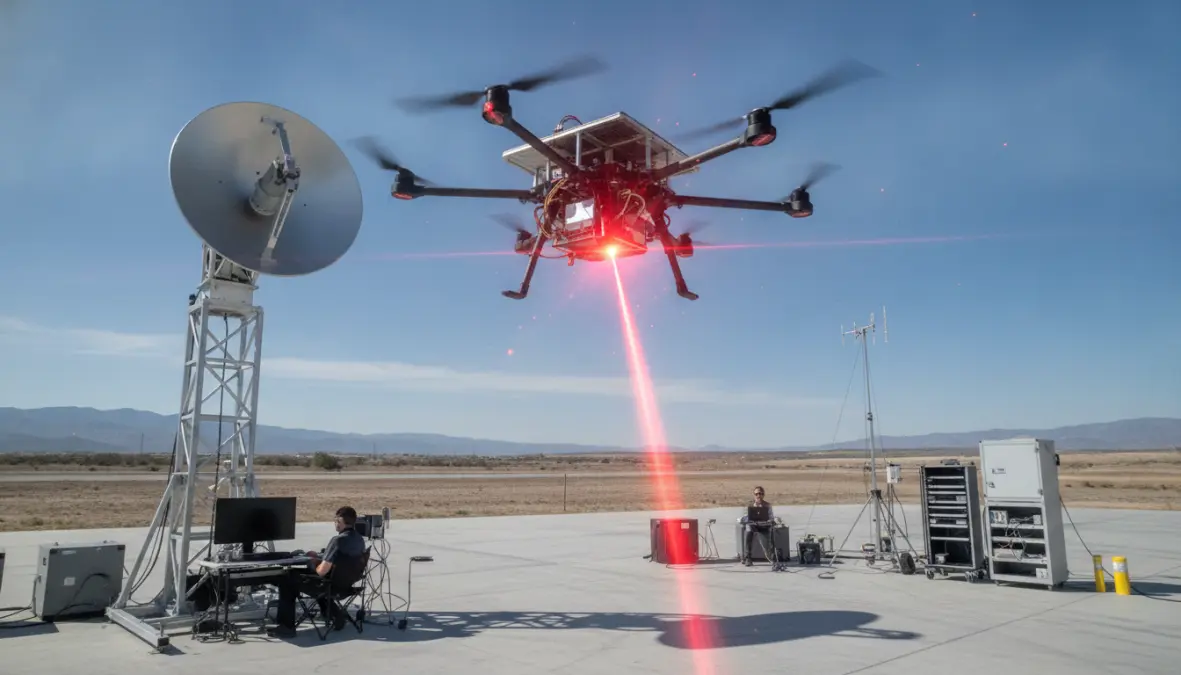
Laser-based systems offer an alternative approach to remote power delivery, converting electricity to coherent light, transmitting it through space, and converting it back to electricity using photovoltaic cells. This method provides exceptional directionality and minimal beam spreading, enabling power transmission over longer distances with smaller receiver sizes compared to RF systems.
The primary advantage lies in the highly focused beam—lasers can deliver kilowatts of power across hundreds of meters or even kilometers with remarkable precision. NASA and several commercial ventures have successfully demonstrated laser power transmission to drones and aircraft, enabling extended flight times without battery weight penalties. However, atmospheric conditions significantly impact performance—fog, rain, and particulate matter can scatter or absorb laser light, reducing efficiency or interrupting transmission entirely. Safety considerations also demand robust systems to prevent accidental exposure, requiring sophisticated tracking and automatic shutdown mechanisms.
Applications, Challenges, and Future of Over-the-Air Charging
Over-the-air charging technology is finding applications across numerous sectors, though significant challenges remain before widespread adoption becomes reality. Understanding both the potential and limitations helps set realistic expectations for this transformative technology.
Current and emerging applications include:
- Internet of Things (IoT) sensors: Wireless power enables truly maintenance-free sensors in industrial facilities, smart buildings, and infrastructure monitoring
- Consumer electronics: Prototype systems demonstrate room-scale charging for smartphones, tablets, and wearables, similar to how ambient computing creates seamless technology integration
- Medical implants: Far-field transmission could power cardiac devices and neural implants without invasive battery replacements
- Drones and robotics: Continuous operation through mid-flight charging or charging zones eliminates downtime for battery swaps
- Space applications: Solar power satellites could beam energy to Earth or power lunar bases
- Electric vehicles: Dynamic charging systems embedded in roadways could extend range and reduce battery requirements
However, significant challenges temper this optimism. Power conversion efficiency remains problematic—losses during transmission mean far-field systems can’t yet compete with wired power for high-energy applications. Distance limitations restrict practical implementations; efficiency drops dramatically with range, making long-distance consumer applications impractical with current technology. Safety concerns regarding prolonged exposure to electromagnetic radiation require careful power level management and regulatory compliance, particularly in occupied spaces.
Regulatory frameworks lag behind technological capabilities, with spectrum allocation and exposure limits varying globally. The technology must also coexist with existing wireless communications without causing interference. Cost remains another barrier—sophisticated beamforming arrays and power electronics make current systems expensive compared to conventional charging solutions.
Despite these hurdles, the future looks promising. Research into advanced metamaterials, improved rectenna technology, and AI-optimized beamforming could dramatically improve efficiency and range. Integration with renewable energy sources, particularly emerging clean energy technologies, could create sustainable wireless power ecosystems. As manufacturing scales up and costs decrease, we’ll likely see far-field wireless power become commonplace for specific applications long before it replaces your phone’s charging cable entirely.
FAQ: Wireless Electricity Transmission
How efficient is current wireless electricity transmission technology?
Efficiency varies significantly by technology and distance. Near-field wireless charging pads achieve 70-80% efficiency, while far-field RF systems typically deliver 20-40% end-to-end efficiency under optimal conditions. Laser-based systems can exceed 50% efficiency in clear atmospheric conditions, but weather impacts performance. Distance dramatically affects all far-field systems—doubling the transmission distance typically reduces received power by 75% or more.
What distances are possible with far-field wireless power?
Current commercial RF systems effectively transmit several watts across 3-10 meters, sufficient for charging phones and powering small devices. Specialized microwave systems have demonstrated kilowatt-level transmission across hundreds of meters in controlled settings. Laser-based systems have successfully delivered power across several kilometers in demonstration projects, though practical applications remain limited. For consumer applications, expect effective ranges under 10 meters for the foreseeable future.
Is wireless power transmission safe for humans and animals?
Properly designed systems operating within regulatory limits pose minimal health risks. Far-field wireless power systems must comply with RF exposure standards set by agencies like the FCC and ICNIRP, which establish safe power density levels. Commercial systems use power levels comparable to Wi-Fi routers and incorporate safety features like automatic shutdown when obstructions (including people) enter the beam path. Long-term exposure research continues, but current evidence suggests properly regulated systems present negligible risk.
How does far-field wireless charging differ from the wireless charging pad I use for my phone?
Your phone’s charging pad uses near-field inductive coupling, transferring energy through magnetic fields over millimeter-to-centimeter distances with high efficiency but requiring precise alignment. Far-field systems use propagating electromagnetic waves (radio waves, microwaves, or light) that can travel across rooms, don’t require precise positioning, and can charge multiple devices simultaneously. The tradeoff is lower efficiency and more complex technology. Think of near-field as a dedicated power cord without the plug, while far-field resembles Wi-Fi for electricity.
The journey from Tesla’s ambitious experiments to today’s sophisticated beamforming systems demonstrates humanity’s persistent drive to untether ourselves from cables and constraints. While wireless electricity transmission won’t replace the electrical grid anytime soon, it’s carving out valuable niches where convenience, accessibility, or functionality outweigh efficiency concerns. As the technology matures alongside other innovations—from advanced power generation to smart infrastructure—we’re building the foundation for a future where power truly is everywhere we need it, whenever we need it. The wireless revolution that transformed communications is now coming for the last wire connecting us to the wall.